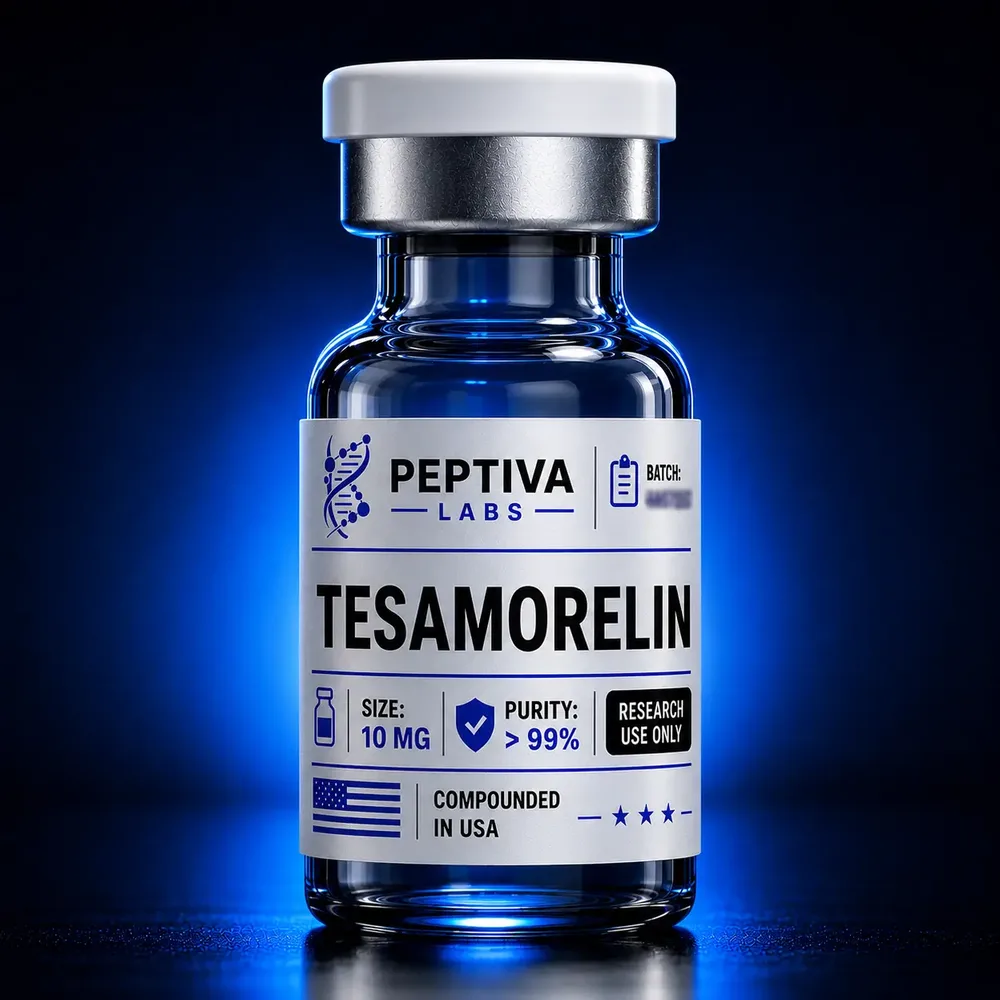
Tesamorelin is a synthetic peptide classified as a growth-hormone-releasing hormone (GHRH) analog. It is structurally based on the native human GHRH(1-44) sequence and carries a stabilizing modification intended to improve resistance to enzymatic degradation. Within laboratory settings, tesamorelin is used as a tool compound for investigating the somatotropic axis and downstream metabolic signaling. This overview summarizes what the compound is and how it is characterized in preclinical and in-vitro research contexts.
What it is
Tesamorelin is a 44-amino-acid peptide analog of endogenous GHRH. The native GHRH(1-44) sequence is the hypothalamic signaling peptide that acts on the anterior pituitary to regulate growth hormone (GH) secretion. The defining structural feature of tesamorelin is an N-terminal modification (a trans-3-hexenoyl group attached to the tyrosine residue), which is studied for its role in increasing stability against dipeptidyl peptidase and other proteolytic activity that rapidly clears native GHRH.
- Class: GHRH analog / growth-hormone-releasing factor (GRF) peptide.
- Parent sequence: human GHRH(1-44).
- Key modification: N-terminal acylation studied for enhanced enzymatic stability.
- Molecular target: the GHRH receptor (GHRHR), a class B G-protein-coupled receptor expressed on pituitary somatotrophs.
Because it retains the receptor-binding determinants of native GHRH while resisting degradation, tesamorelin is frequently examined as a model agonist for studying GHRHR pharmacology relative to the unmodified peptide.
How researchers study its mechanism
In preclinical and cell-based models, tesamorelin is characterized as a GHRHR agonist. Investigators study how engagement of the GHRH receptor couples to Gs proteins, activates adenylate cyclase, and elevates intracellular cyclic AMP, a cascade examined in connection with the synthesis and pulsatile release of growth hormone from somatotroph cells. Researchers use the compound to probe how a stabilized analog modulates this signaling compared with the short-lived native ligand.
A second major line of investigation concerns the broader GH/IGF-1 axis. Growth hormone released downstream of GHRHR activation is associated with hepatic insulin-like growth factor 1 (IGF-1) signaling, and laboratory work examines how analog-driven changes in GH output relate to IGF-1 dynamics in model systems. Tesamorelin is therefore studied as a probe of feedback regulation within the hypothalamic-pituitary-somatotropic axis.
Lipid-metabolism research interest
A distinct area of scientific interest is the intersection of GH-axis signaling and lipid metabolism. Growth hormone signaling has long been characterized in the literature as influencing lipolysis and adipose-tissue dynamics, and tesamorelin is used in preclinical models to examine how GHRHR-mediated modulation of the GH axis associates with lipid-handling parameters. Researchers studying adipocyte biology and metabolic signaling may use the compound to interrogate these pathways in vitro or in animal models. All such work is mechanistic and observational in a laboratory context; it does not establish any human or clinical outcome.
Research considerations
As a peptide reagent, tesamorelin requires handling consistent with other sensitive research peptides. The following considerations are commonly relevant to laboratory work:
- Purity: peptide identity and purity are typically confirmed by high-performance liquid chromatography (HPLC) and mass spectrometry. Reproducible mechanistic data depend on a well-characterized, high-purity reference material.
- Storage: lyophilized peptide is generally stored cold and protected from light and moisture. Reconstituted solutions are less stable and are usually prepared fresh, aliquoted, and kept frozen to limit freeze-thaw cycles.
- Reconstitution: in research settings the peptide is dissolved in an appropriate sterile solvent for the assay; the choice of buffer and concentration is determined by the experimental design and analytical endpoints.
- Documentation: a certificate of analysis (COA) supports traceability and helps ensure that observed effects can be attributed to the intended compound rather than impurities.
Investigators comparing tesamorelin to native GHRH or to other GRF analogs often note its enhanced stability profile as a practical advantage for assays where the rapid clearance of unmodified peptide would otherwise complicate interpretation. Careful control of preparation, storage, and handling variables is important for generating reproducible mechanistic data.
Peptiva Research Labs supplies tesamorelin as a research-grade peptide, HPLC-verified and accompanied by a certificate of analysis documenting identity and purity. This material is intended strictly for laboratory and research applications. For Research Use Only, not for human or veterinary use.