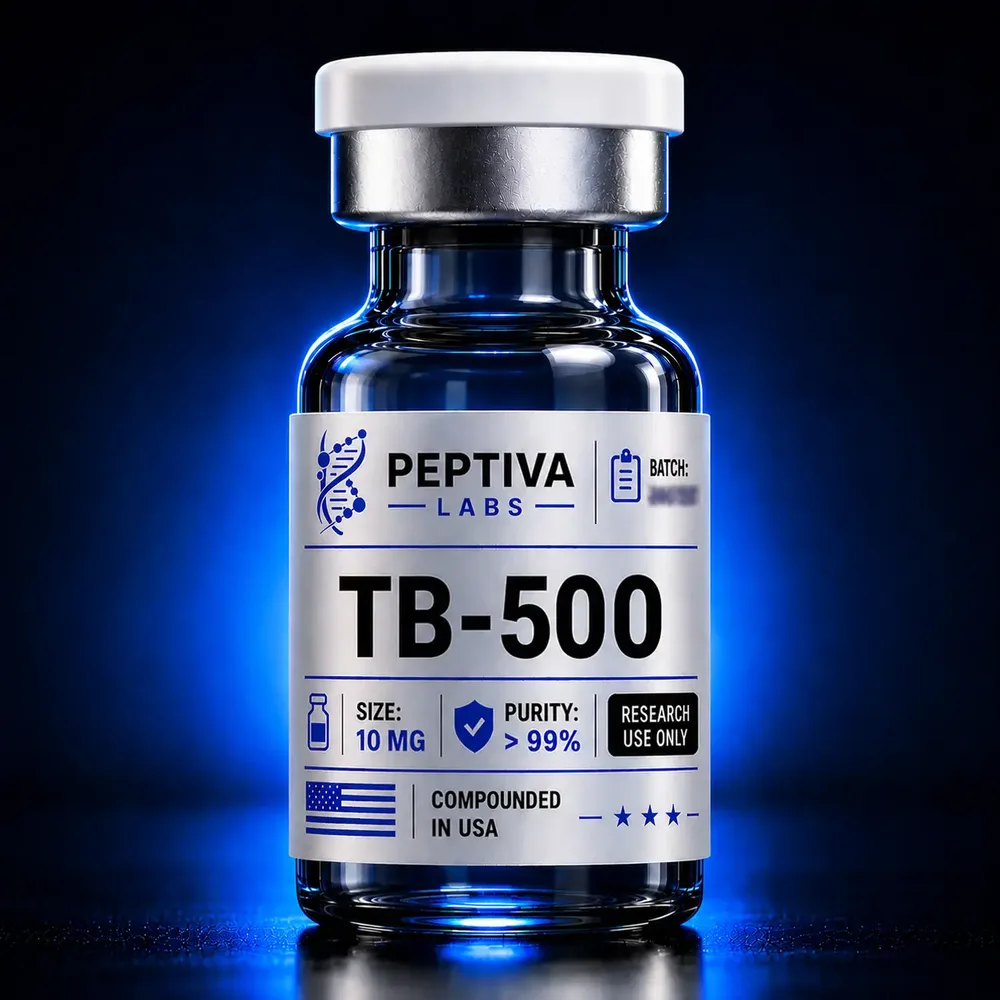
TB-500 is a synthetic peptide corresponding to a biologically active region of thymosin beta-4 (Tβ4), a small, naturally occurring 43-amino-acid protein found across many mammalian cell types and tissues. Within research settings, TB-500 is used as a laboratory tool to examine the molecular activities historically attributed to thymosin beta-4, particularly its role in actin dynamics. This overview summarizes what the compound is and the questions laboratories investigate, framed strictly for in-vitro and preclinical study.
What TB-500 is
Thymosin beta-4 is the most abundant member of the beta-thymosin family and is best characterized as a major intracellular G-actin (monomeric actin) sequestering peptide. TB-500 refers to a synthetic construct built around the segment of Tβ4 associated with actin binding, often described in the literature in connection with the actin-binding domain and the conserved LKKTETQ motif. As a research compound, it is typically supplied as a lyophilized powder and reconstituted in the laboratory for cell-culture or preclinical experimental work.
Because TB-500 represents an active fragment rather than the full-length protein, investigators study it to isolate and characterize specific activities, chiefly the interaction with actin, without the additional sequence context of the parent peptide. It is frequently grouped alongside other regenerative-research peptides in comparative studies, though its mechanism is distinct.
How researchers study its mechanism
The central activity examined in TB-500 research is its relationship to the actin cytoskeleton. Actin polymerization and depolymerization underlie a wide range of cellular behaviors, and beta-thymosins are studied as regulators of the available pool of monomeric actin. Laboratory work commonly explores several interconnected areas:
- Actin regulation: how the peptide's binding to G-actin is characterized, and how shifts in the monomeric actin pool relate to cytoskeletal organization in cultured cells.
- Cell migration: in-vitro assays (such as scratch/wound-closure and transwell models) used to examine how cytoskeletal modulation may influence the motility of cell types including fibroblasts, endothelial cells, and keratinocytes.
- Tissue-repair signaling: preclinical models in which markers and pathways associated with wound-healing biology and extracellular matrix remodeling are measured and characterized.
- Angiogenesis: endothelial cell models and tube-formation assays used to study processes relevant to new blood-vessel formation.
- Inflammatory and oxidative pathways: exploratory work examining how the peptide may interact with signaling cascades reported in the thymosin beta-4 literature.
Across these areas, researchers describe outcomes in terms of measured cellular and molecular endpoints, migration distance, proliferation markers, gene and protein expression, and morphological changes, rather than any clinical outcome. The emphasis is on mechanistic characterization in controlled systems.
Why the fragment is used in study designs
Working with a defined synthetic fragment gives investigators a reproducible, well-specified reagent. This supports comparison across experiments and laboratories and allows the actin-related activity to be probed alongside structure-function studies, including the use of motif variants and control peptides to attribute observed effects to specific sequence regions.
Research considerations: purity, storage, and reconstitution
Peptide identity and purity are foundational to reproducible results. Investigators generally verify TB-500 by analytical methods such as high-performance liquid chromatography (HPLC) for purity and mass spectrometry for molecular weight confirmation before use. Documentation on a certificate of analysis (COA) allows lot-to-lot comparison.
- Storage: lyophilized peptide is typically stored cold and protected from light and moisture; many laboratories keep long-term stocks frozen. Reconstituted material is generally treated as less stable and stored according to the experimental protocol, often aliquoted to limit freeze-thaw cycles.
- Reconstitution: bacteriostatic or sterile water is commonly used in published methods, with gentle handling to avoid degrading the peptide. Solution preparation, concentration, and handling are determined by the study design.
- Controls: vehicle controls and, where relevant, scrambled or motif-modified peptides help isolate sequence-specific effects in cell-based and preclinical assays.
Documenting reconstitution solvent, concentration, storage temperature, and handling steps in laboratory records supports reproducibility and accurate interpretation of cytoskeletal and migration data.
Peptiva Research Labs supplies TB-500 (Thymosin Beta-4 Fragment) as an HPLC-verified research compound accompanied by a certificate of analysis documenting identity and purity, intended to support reproducible in-vitro and preclinical study. For Research Use Only, not for human or veterinary use.