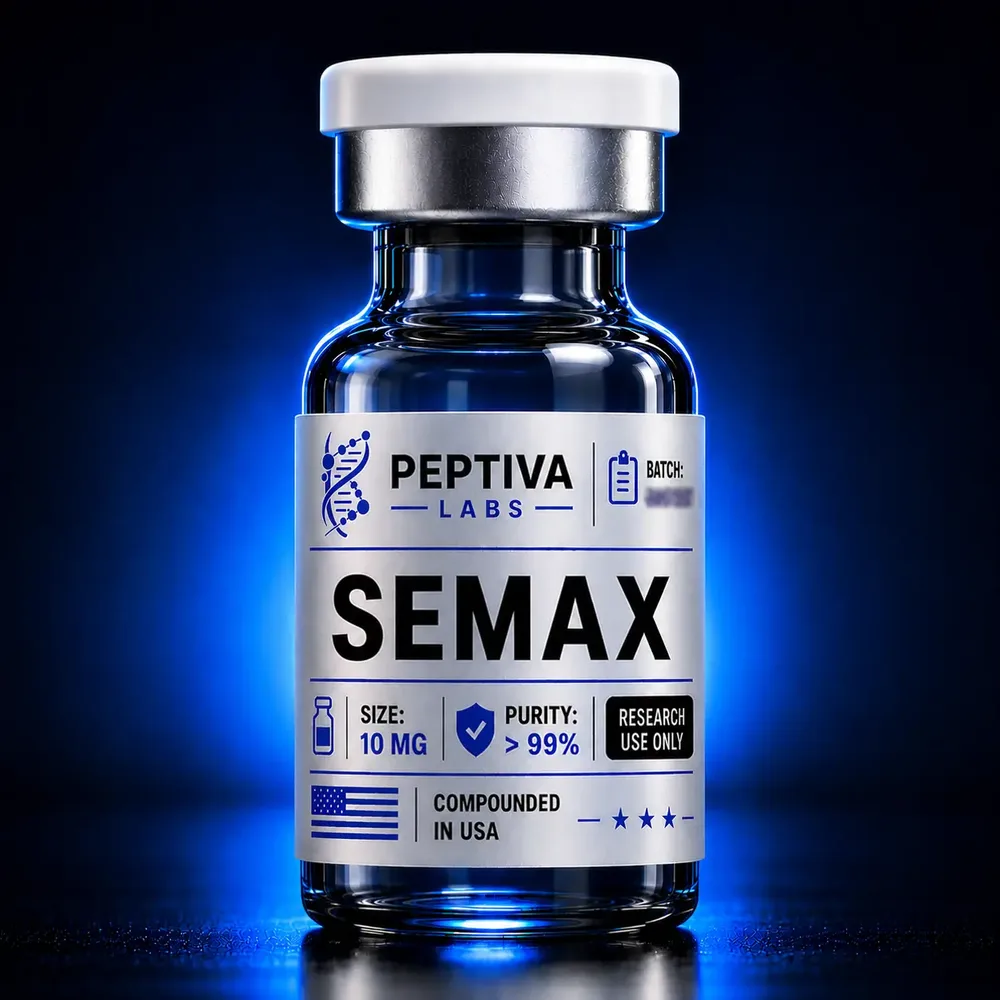
Semax is a synthetic peptide derived from the 4-10 fragment of adrenocorticotropic hormone (ACTH), a sequence historically of interest to researchers because the ACTH(4-10) region carries behavioral and neurotrophic activity that is structurally separable from the hormone's steroidogenic (corticotropic) effects. As a melanocortin-derived analog, Semax has become a frequently characterized tool compound in laboratory neuroscience, where it is examined in cell cultures and preclinical models for its reported influence on neurotrophic signaling, neuronal survival, and cognition-associated readouts.
What it is
Semax is a short peptide built on the heptapeptide ACTH(4-10) core (Met-Glu-His-Phe-Pro-Gly-Pro) with a C-terminal Pro-Gly-Pro extension. This terminal tripeptide is a key design feature: it confers substantial resistance to enzymatic degradation by aminopeptidases and other proteases, extending the compound's stability relative to the native fragment. Because the corticotropic portion of full-length ACTH is not present, Semax is generally classified as a "non-corticotropic" ACTH analog, meaning research interest centers on its neuromodulatory rather than endocrine properties.
Key descriptive characteristics that laboratories catalog include:
- Class: synthetic melanocortin / ACTH(4-10) analog peptide.
- Core sequence: ACTH(4-10) fragment with a Pro-Gly-Pro stabilizing tail.
- Structural rationale: the added tripeptide is studied as a determinant of metabolic stability.
- Research category: investigated as a neuroprotective and nootropic-associated tool compound.
How researchers study it
Mechanistic work on Semax in cell and animal models frequently focuses on its relationship to neurotrophic systems. A recurring theme in the literature is the brain-derived neurotrophic factor (BDNF) pathway: studies examine whether exposure to Semax is associated with changes in BDNF and its receptor TrkB, along with downstream signaling cascades implicated in neuronal plasticity and survival. Related work characterizes nerve growth factor (NGF) signaling, since the ACTH/melanocortin family has long been connected to neurotrophin biology.
Investigators commonly use Semax to probe questions such as:
- Neurotrophic expression: transcriptomic and protein-level analyses of BDNF, NGF, and associated genes in neuronal cultures and brain tissue from model organisms.
- Neuroprotection: cell-based assays examining neuronal viability under stressors such as oxidative challenge, excitotoxic conditions, or oxygen-glucose deprivation used to model ischemia in vitro.
- Signaling pathways: characterization of kinase cascades and transcription-factor activity downstream of neurotrophin receptors.
- Behavioral and cognitive readouts: preclinical rodent paradigms used to study learning- and memory-associated endpoints, which is where the "nootropic" research framing originates.
- Melanocortin receptor interactions: studies that explore how ACTH-derived sequences engage melanocortin system components.
Because Semax is a peptide, researchers also characterize its pharmacokinetic and metabolic behavior, including the formation of degradation fragments and the role of the Pro-Gly-Pro motif in extending half-life. It is important to note that all such work is conducted in vitro or in preclinical animal models; the findings describe biological mechanisms under investigation and are not statements about outcomes in humans.
Research considerations: purity, storage, and reconstitution
As with any peptide used as an experimental reference standard, data quality depends heavily on the integrity of the material. Researchers typically prioritize the following:
- Purity verification: peptide identity and purity are confirmed by analytical methods such as high-performance liquid chromatography (HPLC) and mass spectrometry, and a certificate of analysis (COA) is used to document lot-specific results.
- Storage: lyophilized peptide is generally stored cold and protected from light and moisture to preserve stability; many laboratories keep long-term stocks frozen and minimize freeze-thaw cycles.
- Reconstitution: for laboratory preparation, an appropriate research-grade solvent is selected based on the experimental protocol, with attention to sterility and to avoiding conditions that promote peptide aggregation or hydrolysis.
- Handling controls: consistent aliquoting and documented handling support reproducibility across experiments.
These considerations help ensure that observed effects in a model system reflect the compound under study rather than degradation artifacts or contaminants.
Peptiva Research Labs supplies Semax (ACTH 4-10 analog) as an HPLC-verified research material accompanied by a certificate of analysis documenting identity and purity for laboratory characterization. This product is intended For Research Use Only, not for human or veterinary use. The information above summarizes how the compound is studied in in-vitro and preclinical settings and is provided strictly for educational and scientific reference.