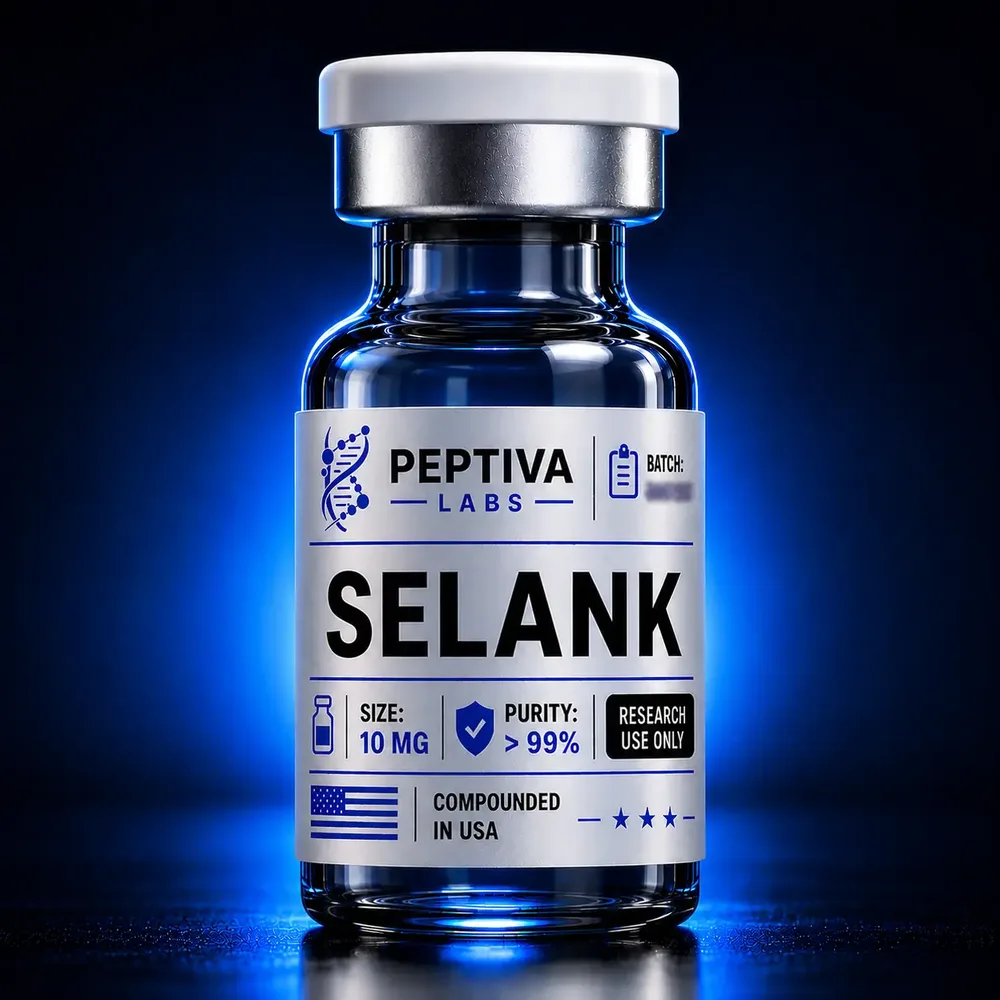
Selank is a synthetic heptapeptide that has become a frequent subject of neuropeptide research, particularly in studies examining anxiolytic-like and nootropic-related signaling. Structurally, it is an analog of the endogenous immunomodulatory peptide tuftsin, modified to improve stability for laboratory characterization. This overview summarizes what Selank is as a molecule and how investigators study it in in-vitro and preclinical contexts. It is intended strictly for educational and research reference and does not describe human or veterinary use.
What Selank Is
Selank is a short peptide composed of seven amino acids, commonly represented by the sequence Thr-Lys-Pro-Arg-Pro-Gly-Pro. It was developed as a synthetic derivative of tuftsin, a naturally occurring tetrapeptide fragment associated with immune signaling. The added proline-glycine-proline extension is generally described in the literature as a design feature intended to increase enzymatic resistance and prolong the molecule's stability relative to native tuftsin, making it more tractable for experimental work.
Because of its tuftsin lineage, Selank is often categorized at the intersection of two research areas: neuropeptide modulation of behavior and peptide-mediated immune signaling. Investigators characterize it as a small, water-soluble peptide whose compact structure is amenable to standard analytical methods such as high-performance liquid chromatography (HPLC) and mass spectrometry for identity and purity confirmation.
How Researchers Study It
In preclinical and in-vitro settings, Selank is examined primarily for how it may influence neurochemical and signaling pathways associated with stress-response and cognition-related research models. Several mechanistic themes recur in the published literature:
- Monoamine-related pathways: Studies have examined how Selank may interact with serotonergic and dopaminergic signaling, including effects on monoamine turnover and metabolism in brain-tissue models. Researchers characterize these interactions to understand the peptide's reported anxiolytic-like profile in animal behavioral paradigms.
- GABAergic and benzodiazepine-receptor context: Some investigations situate Selank's anxiolytic-like activity within GABAergic signaling, and it is frequently compared with classical anxiolytics in mechanistic discussions, while being noted as structurally and pharmacologically distinct.
- BDNF and neurotrophic signaling: A notable line of research examines Selank's relationship to brain-derived neurotrophic factor (BDNF) and related gene-expression patterns. Studies have measured changes in BDNF expression in hippocampal tissue of model organisms to explore possible links to learning- and memory-related endpoints.
- Immune and cytokine signaling: Reflecting its tuftsin origin, Selank is studied for effects on cytokine balance and interleukin expression, including markers associated with inflammatory and anti-inflammatory signaling. This work explores the peptide's dual neuro-immune characterization.
- Enkephalin and peptidase activity: Some research examines how Selank may influence the activity of enzymes that degrade endogenous regulatory peptides, which is one proposed contributor to its observed signaling effects.
Typical experimental approaches include rodent behavioral assays (such as elevated-plus-maze and open-field paradigms used to model anxiety-like behavior), gene-expression and protein-quantification assays, and biochemical analyses of neurotransmitter and cytokine levels. These methods allow researchers to characterize what the peptide does at a signaling level without making claims about clinical outcomes.
Research Considerations: Purity, Storage, and Reconstitution
For reproducible results, peptide identity and purity are critical experimental variables. Selank used in research is generally characterized by HPLC to confirm purity and by mass spectrometry to verify molecular identity. Laboratories typically document these parameters before use so that observed effects can be attributed to the intended compound rather than synthesis byproducts.
As a lyophilized peptide, Selank is commonly stored desiccated and protected from light, with long-term storage at low temperatures (such as freezer conditions) to preserve integrity. Short peptides can be sensitive to repeated temperature cycling, so researchers often aliquot stock to minimize freeze-thaw exposure. When reconstituted for in-vitro or preclinical model work, an appropriate sterile, compatible solvent is selected per the laboratory's protocol, and reconstituted material is generally handled under conditions that limit microbial contamination and degradation.
Documentation practices, including recording lot numbers, certificates of analysis, and storage history, support traceability and help contextualize experimental variability across studies.
Summary
Selank is a synthetic, tuftsin-derived heptapeptide characterized in research for its potential influence on anxiolytic-like behavior, cognition-related endpoints, and neuro-immune signaling, with particular attention in the literature to BDNF, monoamine, and cytokine-related pathways in preclinical models. It remains a tool compound for investigators studying neuropeptide mechanisms rather than a product with established applications outside the laboratory.
Peptiva Research Labs supplies Selank as an HPLC-verified peptide accompanied by a Certificate of Analysis (COA) documenting purity and identity. For Research Use Only, not for human or veterinary use.