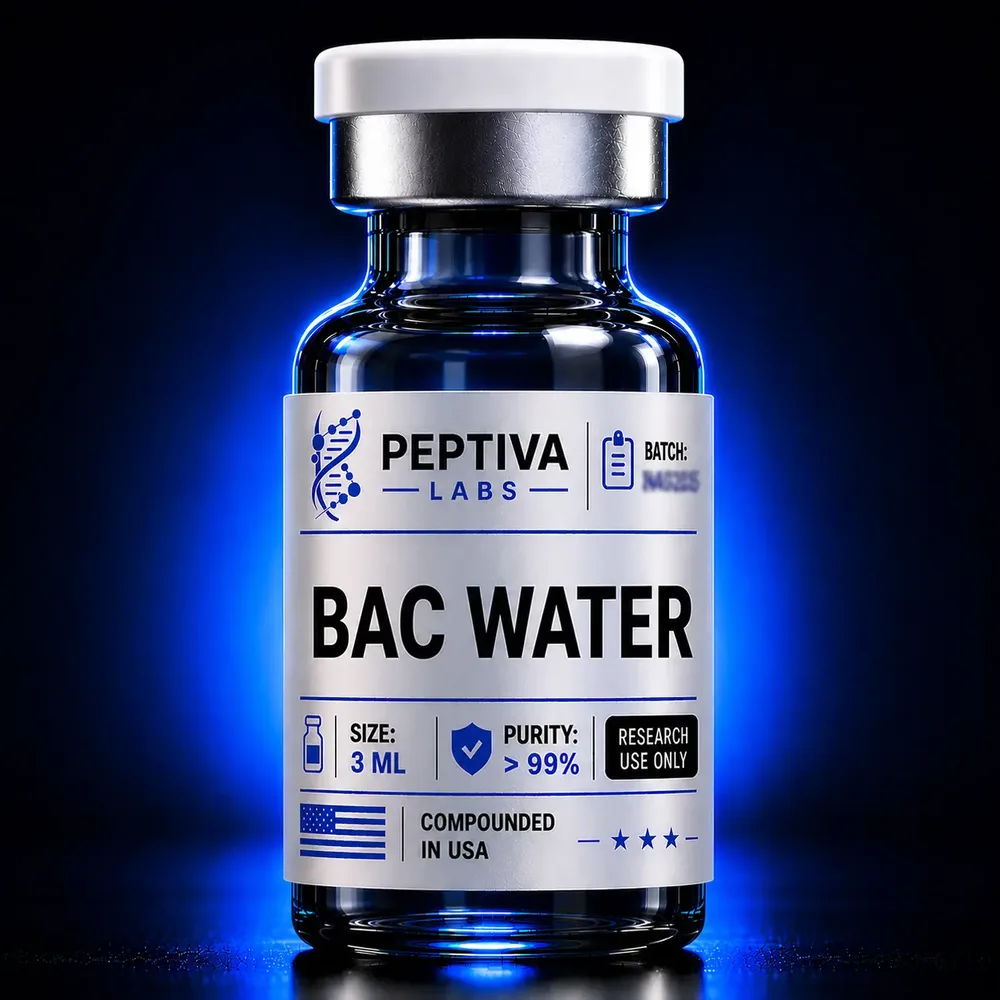
Most research peptides are shipped as a lyophilized (freeze-dried) powder because the solid state is far more stable during storage and transit than a solution. Before a peptide can be used in any in-vitro or preclinical workflow, it must be reconstituted, dissolved back into a liquid so that a defined concentration can be measured and handled. This guide describes the laboratory considerations around reconstitution, including the role of bacteriostatic water, the arithmetic of preparing a working concentration, sterile technique, aliquoting, and freeze-thaw stability. It is a benchtop handling reference only and is not a guide to administration of any kind.
What bacteriostatic water is
Bacteriostatic water for injection is sterile water that contains 0.9% benzyl alcohol as a preservative. The benzyl alcohol is bacteriostatic, meaning it inhibits the growth of bacteria within the vial, which is why it is commonly selected as a diluent when a reconstituted peptide stock may be drawn from repeatedly over a period of time. This contrasts with sterile water for injection, which contains no preservative, and with normal saline. The choice of diluent in a laboratory setting depends on the solubility profile of the specific peptide and the stability data the researcher is working from.
Some peptides are poorly soluble in plain or bacteriostatic water and are characterized in the literature using small amounts of dilute acetic acid, ammonium hydroxide, or other solvents to achieve full dissolution before the volume is brought up with an aqueous diluent. The appropriate solvent is a property of the molecule and should be determined from the compound's documentation rather than assumed.
Reconstitution math
The concentration of a reconstituted stock is simply the mass of peptide divided by the volume of diluent added. The core relationship researchers use is:
- Concentration = mass of peptide / volume of diluent. For example, 5 mg of peptide dissolved in 2 mL of diluent yields a stock of 2.5 mg/mL.
- Total peptide mass is fixed by the vial. Adding more diluent lowers the concentration but does not change the total amount of compound present.
- Working concentration is chosen for assay convenience. A more dilute stock makes small quantities easier to measure accurately; a more concentrated stock conserves volume.
Researchers typically record the lot number, the mass stated on the certificate of analysis, the diluent and volume used, and the resulting concentration, so that downstream measurements are traceable.
Sterile technique and the reconstitution step
Good aseptic practice protects both the integrity of the sample and the reproducibility of any assay. Common laboratory considerations include:
- Wiping the vial stopper and the diluent vial with an alcohol pad before each puncture.
- Introducing diluent slowly and letting it run down the inner wall of the vial rather than directly onto the peptide cake, which reduces foaming and shear.
- Not shaking the vial. Vigorous agitation can denature sensitive peptides; the vial is gently swirled or left to stand until the powder fully dissolves.
- Inspecting the reconstituted solution for clarity, since persistent cloudiness or particulates can indicate incomplete dissolution or a solubility mismatch.
Aliquoting and freeze-thaw considerations
Once in solution, many peptides are less stable than they were as a dry powder, and repeated temperature cycling is a recognized source of degradation. To limit this, laboratories frequently divide a reconstituted stock into single-use aliquots in clean, labeled tubes and freeze them. This way, each experiment thaws only the volume it needs, and the remaining material is never subjected to repeated freeze-thaw cycles, which can promote aggregation, oxidation, or loss of activity in susceptible sequences.
General handling practices that are widely characterized in peptide stability work include keeping working solutions cold, minimizing exposure to light for photosensitive compounds, and avoiding extended time at room temperature. The exact stability window is sequence-dependent, so researchers rely on empirical data and the compound's documentation rather than a single universal rule.
Purity and storage of the starting material
Reconstitution can only ever be as good as the powder going into the vial. A peptide of low purity introduces unknown contaminants that confound assay results, which is why HPLC-verified purity and a certificate of analysis matter before any diluent is added. Lyophilized peptides are generally stored cold and kept desiccated and sealed until the moment of reconstitution to preserve the freeze-dried cake.
Peptiva Research Labs supplies its research peptides as HPLC-verified lyophilized material accompanied by a certificate of analysis documenting identity and purity, so the reconstitution math and handling described here can be performed against a known starting reference. All products are sold strictly For Research Use Only, not for human or veterinary use.