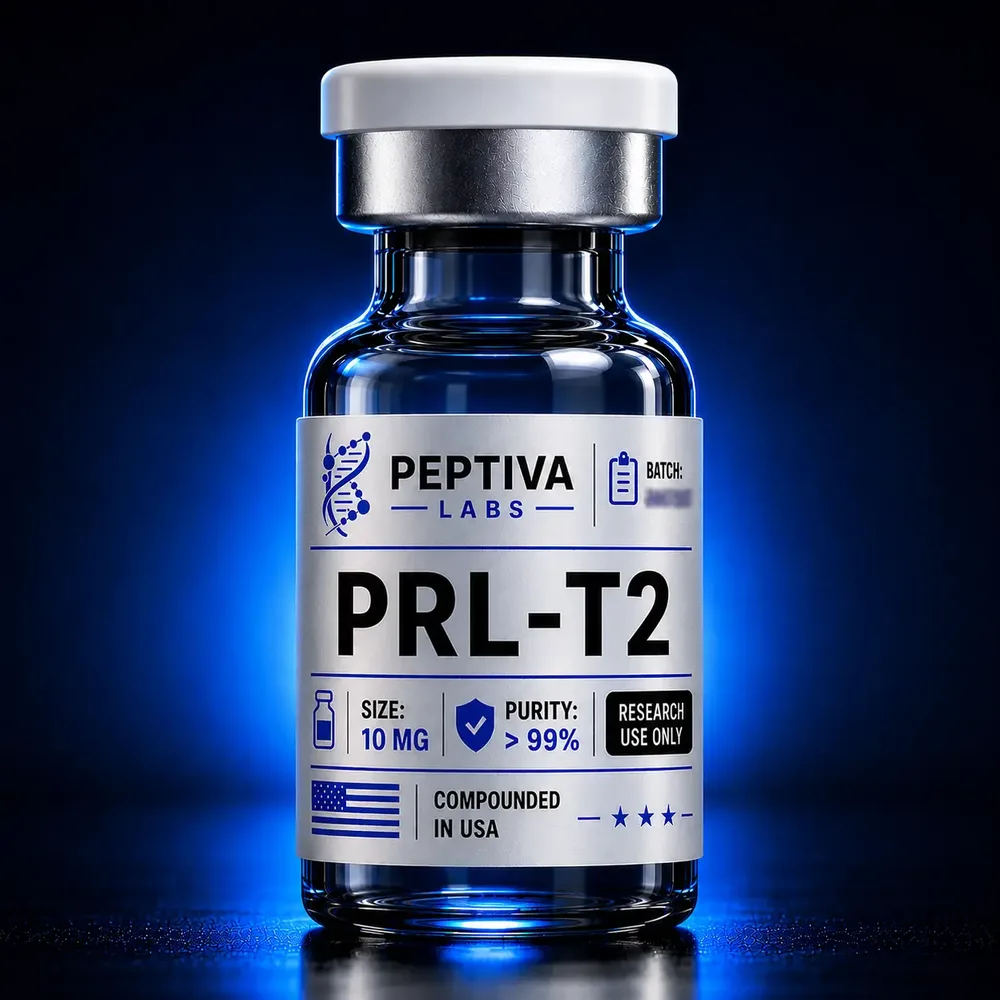
PRL-T2 is a synthetic peptide belonging to the tirzepatide research class, a category of engineered dual agonists that activate two distinct incretin receptors. In laboratory settings, it is studied as a single-molecule probe for examining how simultaneous engagement of the glucose-dependent insulinotropic polypeptide (GIP) receptor and the glucagon-like peptide-1 (GLP-1) receptor shapes downstream signaling. This article summarizes what PRL-T2 is and how research groups characterize it, framed strictly for in-vitro and preclinical investigation.
What it is
PRL-T2 is a long-chain synthetic peptide modeled on the tirzepatide structural class. Its defining feature is dual receptor agonism: a single sequence designed to bind and activate both the GIP receptor and the GLP-1 receptor, which are members of the class B (secretin-like) family of G-protein-coupled receptors (GPCRs). Peptides in this class typically carry a fatty-acid moiety conjugated to the backbone, a modification studied for its influence on albumin association and in-vitro stability.
The two target receptors are central to the incretin system, a set of signaling pathways researchers examine in the context of nutrient sensing and metabolic regulation. Native GIP and GLP-1 are short-lived signaling peptides; engineered dual agonists like PRL-T2 are used as tools to probe what happens when both receptor arms are engaged by one ligand rather than two separate native hormones. Key attributes studied include:
- Receptor selectivity profile, the relative potency at GIP versus GLP-1 receptors, often expressed as a comparative activation ratio in cell-based systems.
- Biased signaling, whether the peptide preferentially recruits G-protein versus beta-arrestin pathways at each receptor.
- Structural stability, resistance to enzymatic cleavage in buffered in-vitro conditions, a property of interest for assay reproducibility.
How researchers study it
Because GIP and GLP-1 receptors both couple to Gs proteins and elevate intracellular cyclic AMP (cAMP), much of the in-vitro work centers on cAMP accumulation assays. Researchers transfect cell lines such as HEK293 or CHO with recombinant human GIP or GLP-1 receptors, expose them to graded concentrations of PRL-T2, and quantify the cAMP response. Plotting these data yields concentration-response curves from which potency (EC50) and efficacy values are derived for each receptor independently.
Complementary approaches include:
- Reporter gene assays, cAMP-response-element (CRE) luciferase constructs provide an amplified, quantitative readout of receptor activation, useful for screening relative agonist activity across the two receptor arms.
- Beta-arrestin recruitment assays, enzyme-fragment-complementation or BRET-based platforms characterize receptor internalization and signaling bias, parameters examined to understand how dual agonists differ from single-receptor ligands.
- Radioligand and fluorescent binding studies, used to characterize binding affinity and competition at each receptor site.
- Glucose-regulation models, in isolated islet or insulinoma cell-line systems (for example, pancreatic beta-cell models), researchers study glucose-dependent insulin secretion in vitro to characterize how combined incretin signaling modulates the secretory response under defined glucose conditions.
The scientific interest in dual agonism is largely comparative: laboratories examine whether engaging both receptors with one molecule produces signaling outputs distinct from the sum of two separate single-receptor agonists. PRL-T2 serves as a reference tool compound in these mechanistic comparisons, and its behavior is typically benchmarked against established single-target incretin peptides run in parallel.
Research considerations
For reproducible results, the physical quality of the peptide is a primary variable. Long fatty-acid-modified peptides can show batch-to-batch variation, so investigators rely on documented analytical characterization.
- Purity verification, reversed-phase HPLC establishes chromatographic purity, while mass spectrometry confirms the expected molecular weight and the presence of the intended modifications. These data should accompany each lot.
- Reconstitution, lyophilized peptide is typically brought into solution with sterile, appropriately buffered diluent; gentle handling helps avoid aggregation of the lipidated sequence. Aliquoting before storage limits freeze-thaw exposure.
- Storage, lyophilized material is generally held cold and protected from moisture and light, with reconstituted working solutions kept cold and used within a validated window. Repeated freeze-thaw cycles are avoided to preserve assay integrity.
- Documentation, recording lot numbers, reconstitution dates, and solvent systems supports traceability across experiments and aids cross-laboratory comparison.
Peptiva Research Labs supplies PRL-T2 as an HPLC-verified research peptide accompanied by a Certificate of Analysis (COA) documenting purity and identity. For Research Use Only, not for human or veterinary use. This material is intended exclusively for in-vitro and laboratory research by qualified professionals and is not a drug, supplement, or article for diagnostic or therapeutic application.