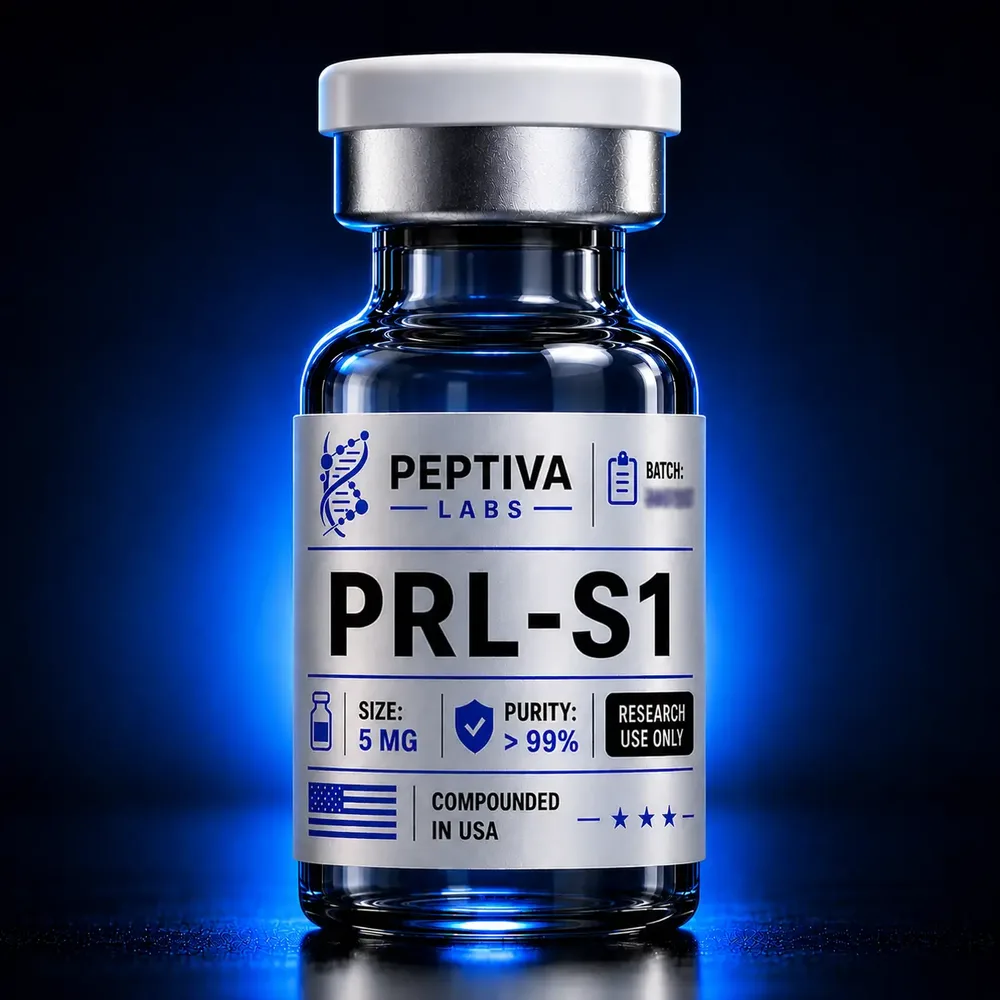
PRL-S1 is a long-acting glucagon-like peptide-1 (GLP-1) receptor agonist belonging to the semaglutide research class. It is supplied strictly as a laboratory reference compound for in-vitro and preclinical investigation. This overview describes what PRL-S1 is as a molecular entity, the receptor systems it engages, and the signaling and homeostasis models that laboratories use to characterize agonists of this class. Nothing here describes or implies human or veterinary use.
What PRL-S1 is
PRL-S1 is a synthetic, acylated peptide analog modeled on the incretin hormone GLP-1. Native GLP-1 is a short peptide secreted by intestinal L-cells that acts on the GLP-1 receptor, a class B G-protein-coupled receptor (GPCR). Native GLP-1 is rapidly inactivated by the enzyme dipeptidyl peptidase-4 (DPP-4), giving it a very short half-life in biological matrices. Semaglutide-class analogs such as PRL-S1 are engineered to resist DPP-4 cleavage and to bind albumin through a fatty-acid side chain, which extends their persistence in laboratory and preclinical model systems. These structural features make PRL-S1 a useful tool for studying sustained GLP-1 receptor engagement compared with the transient signaling produced by the native peptide.
As a research material, PRL-S1 is characterized by its peptide sequence, molecular weight, acylation pattern, and physicochemical behavior in solution. These attributes are the focus of analytical characterization rather than any functional outcome in an organism.
How researchers study it: receptor target and cAMP signaling
The defining experimental property of PRL-S1 is its interaction with the GLP-1 receptor. Because this receptor is a class B GPCR coupled predominantly to the stimulatory G-protein (Gs), agonist binding is examined through its downstream effect on adenylyl cyclase and the resulting accumulation of cyclic AMP (cAMP). Common laboratory approaches include:
- Receptor binding assays using cell lines that recombinantly express the human GLP-1 receptor, to characterize affinity and competition with reference ligands.
- cAMP accumulation assays (for example, time-resolved FRET or luminescence-based reporters) that quantify agonist potency and efficacy at the receptor.
- β-arrestin recruitment and receptor internalization assays that examine signaling bias and trafficking patterns, which are of interest when comparing analogs within the class.
- Downstream reporter systems, such as cAMP-response-element (CRE) luciferase constructs, used to read out transcriptional consequences of receptor activation.
These cell-based and biochemical systems allow researchers to place PRL-S1 on concentration-response curves and to compare its in-vitro pharmacology with that of native GLP-1 and other engineered analogs.
Appetite and glucose-homeostasis models
Because GLP-1 receptors are expressed in pancreatic islets and in central nervous system regions that participate in energy balance, agonists of this class are widely examined in preclinical homeostasis models. Investigators study insulinotropic signaling in isolated or cultured pancreatic beta-cell systems, where glucose-dependent insulin secretion is a classic readout of GLP-1 receptor activity. Central nervous system and rodent feeding-behavior paradigms are used to characterize how sustained receptor agonism interacts with appetite and energy-homeostasis circuitry. In these preclinical settings, endpoints such as receptor expression, signaling activity, and physiological responses are measured to understand the biology of GLP-1 receptor agonism. All such work is conducted in laboratory and animal-model contexts for scientific characterization only.
Research considerations: purity, storage, and reconstitution
Acylated peptides like PRL-S1 require careful handling to preserve experimental integrity. Key considerations that laboratories typically address include:
- Purity and identity. Lot-to-lot consistency matters for reproducible assay results. High-performance liquid chromatography (HPLC) and mass spectrometry are standard for confirming purity and molecular identity before use.
- Storage. Lyophilized peptide is generally stored cold and protected from moisture and light. Reconstituted material is typically aliquoted to minimize freeze-thaw cycles, which can degrade peptide integrity.
- Reconstitution. The fatty-acid side chain influences solubility, so researchers select reconstitution buffers compatible with their assay system and verify that the dissolved material behaves consistently across experiments.
- Documentation. Recording lot numbers, certificates of analysis, and storage conditions supports traceability and experimental reproducibility.
Attention to these factors helps ensure that observed signaling responses reflect the compound's intrinsic pharmacology rather than degradation or handling artifacts.
Peptiva Research Labs supplies PRL-S1 as an HPLC-verified research material accompanied by a Certificate of Analysis (COA) documenting purity and identity. For Research Use Only, not for human or veterinary use. This material is intended exclusively for in-vitro and laboratory investigation by qualified researchers.