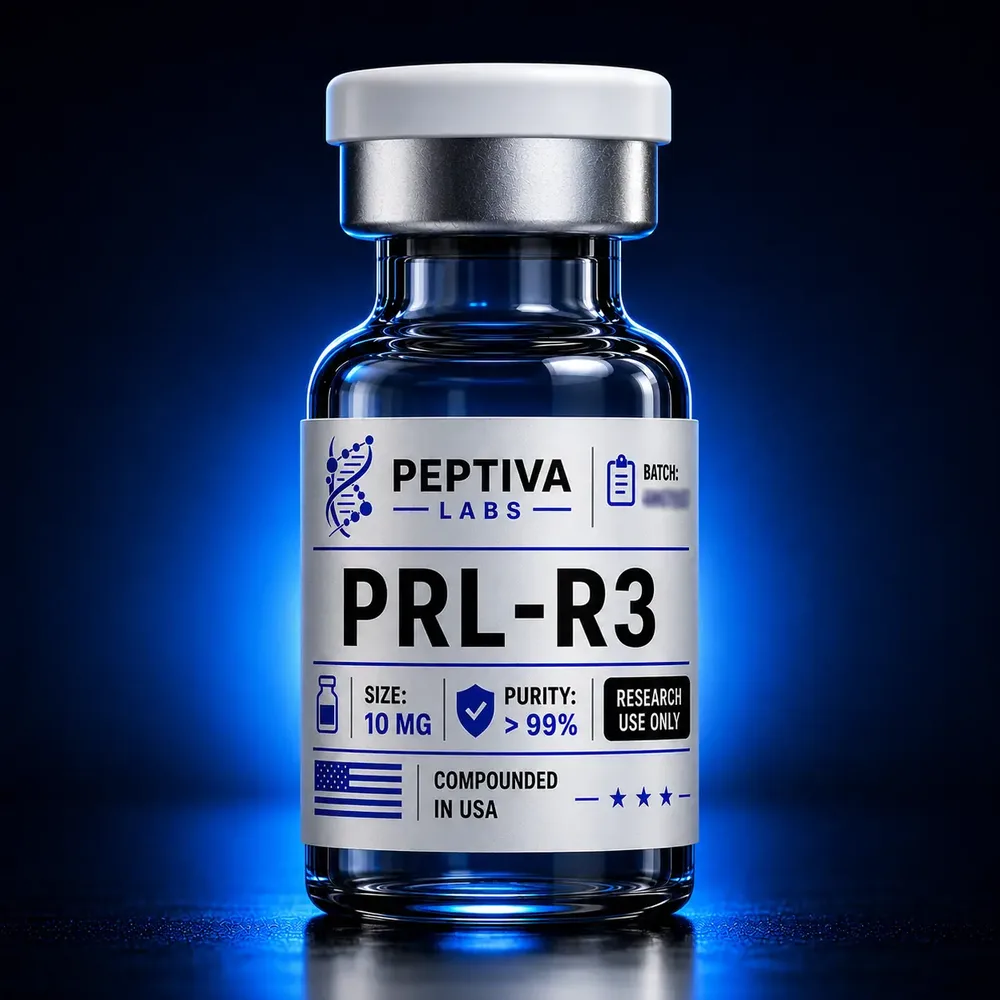
PRL-R3 belongs to the retatrutide research class of synthetic peptides engineered to engage three distinct incretin and metabolic receptors at once. It is studied as a single-molecule, multi-receptor agonist that simultaneously targets the glucose-dependent insulinotropic polypeptide (GIP) receptor, the glucagon-like peptide-1 (GLP-1) receptor, and the glucagon (GCG) receptor. This article summarizes, for laboratory and educational purposes only, what PRL-R3 is as a chemical entity and how investigators characterize it in cell-based and preclinical models.
What it is
PRL-R3 is a peptide agonist patterned on the triagonist design concept that has driven interest in retatrutide-class molecules. Unlike single- or dual-receptor agonists, a triple agonist is designed so that one backbone sequence carries the structural determinants needed to bind and activate three separate G-protein-coupled receptors. Researchers describe these compounds in terms of receptor selectivity ratios, the relative balance of GIP, GLP-1, and glucagon receptor engagement, because that balance is the primary variable distinguishing one triagonist from another.
- GIP receptor: an incretin target examined in models of insulin secretion and lipid handling.
- GLP-1 receptor: the most extensively characterized incretin receptor, widely used as a reference point in comparative agonist studies.
- Glucagon receptor: a target associated in research literature with hepatic energy expenditure pathways, which differentiates triple agonists from incretin-only molecules.
The peptide is typically lipidated or otherwise modified to extend its half-life in experimental systems, a structural feature investigators characterize alongside the receptor-binding domains.
How researchers study it
Laboratory characterization of PRL-R3 generally begins with in-vitro receptor pharmacology. Investigators use cell lines expressing each individual receptor to measure binding affinity and functional activation, most commonly via cyclic AMP (cAMP) accumulation assays, since all three target receptors signal through Gs-coupled cAMP pathways. These assays generate concentration-response curves that allow comparative potency to be expressed as EC50 values at each receptor, and they let researchers map the three-way activity profile that defines the molecule.
Comparative work places PRL-R3 against established single agonists (such as GLP-1 receptor reference peptides) and dual agonists to examine how adding glucagon-receptor activity shifts the in-vitro signature. Selectivity and bias studies look at whether the compound preferentially recruits particular downstream signaling arms.
Beyond cell systems, the retatrutide research class is examined in preclinical energy-balance models. In these studies, investigators characterize effects on parameters such as food intake, body-weight trajectory, glucose tolerance, and indices of energy expenditure in laboratory animal systems. The rationale studied in the literature is that combining incretin-driven effects with glucagon-receptor-linked energy expenditure may produce a metabolic profile distinct from incretin-only agonists. All such work is conducted in controlled preclinical settings and reported as model data, not as evidence of any human outcome.
Comparative potency considerations
Because PRL-R3 is a triagonist, researchers emphasize that "potency" is not a single number. A given preparation may be highly potent at one receptor and comparatively weaker at another, and the in-vitro ratio observed across the three receptors is what laboratories report when comparing batches or comparing the compound to other triagonists. Reproducibility of these ratios depends heavily on peptide purity and correct handling.
Research considerations: purity, storage, and reconstitution
Reliable receptor-pharmacology data depend on a well-characterized starting material. For PRL-R3, the following considerations are routinely emphasized in laboratory practice:
- Purity: peptide purity is assessed by reversed-phase HPLC, with identity confirmed by mass spectrometry. Truncated or deletion sequences can alter receptor binding, so purity verification is central to interpretable triagonist data.
- Storage: lyophilized peptide is typically stored desiccated and frozen, protected from light and repeated temperature cycling, to preserve integrity over the study period.
- Reconstitution: in research workflows the compound is reconstituted in an appropriate sterile diluent, with aliquoting recommended to avoid repeated freeze-thaw cycles that can degrade lipidated peptides.
Documenting these variables allows different laboratories to compare in-vitro and preclinical results on a common footing, which is especially important for multi-receptor molecules where small changes in material quality can shift the apparent receptor balance.
Peptiva Research Labs supplies PRL-R3 as a research-grade material, HPLC-verified for purity and accompanied by a Certificate of Analysis (COA) documenting identity and quality data. For Research Use Only, not for human or veterinary use. All descriptions above relate solely to in-vitro, laboratory, and preclinical characterization and are provided for educational purposes.