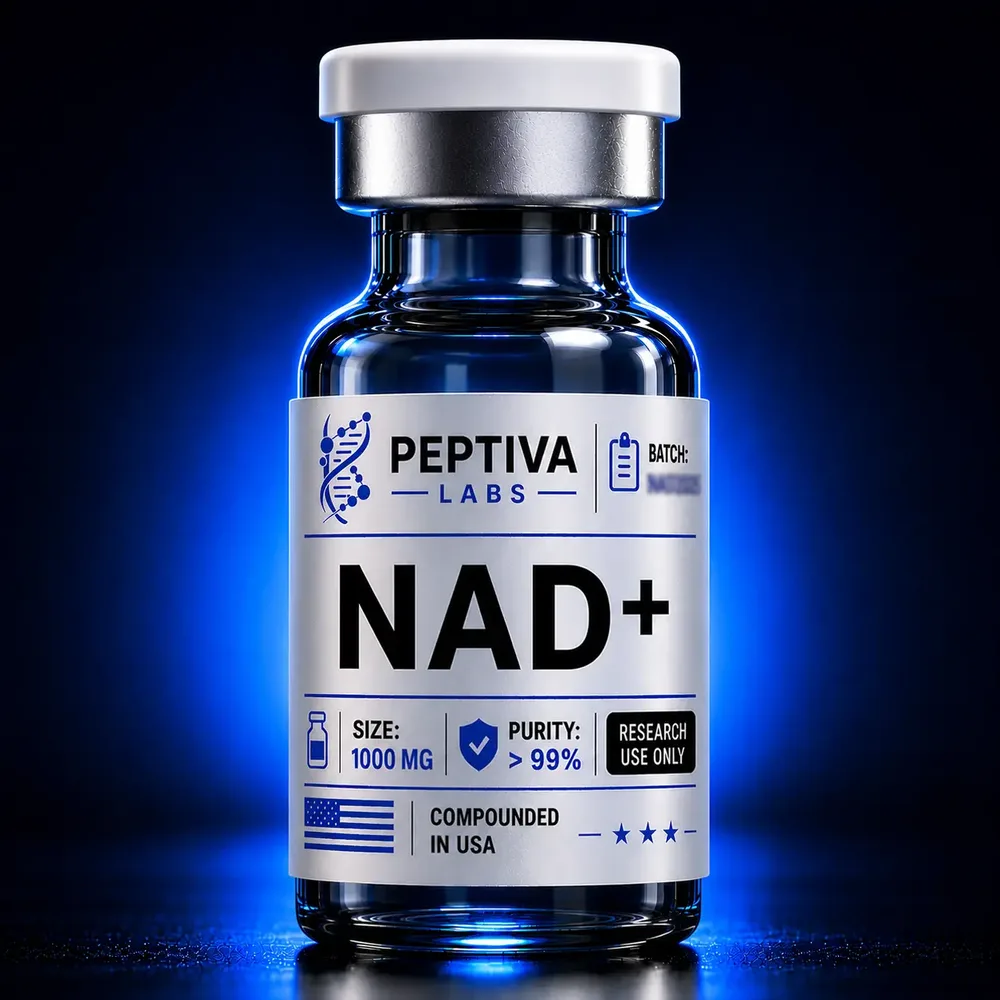
Nicotinamide adenine dinucleotide (NAD+) is one of the most extensively characterized coenzymes in cell biology, functioning as a central electron carrier in metabolism and as a substrate for several families of signaling enzymes. In laboratory and preclinical research, NAD+ is studied both as a redox cofactor that links catabolic and anabolic pathways and as a consumable metabolite whose availability is examined in relation to sirtuin and PARP activity. This overview summarizes what NAD+ is and how researchers investigate it in vitro, framed strictly for educational and research contexts.
What NAD+ Is
NAD+ is a dinucleotide composed of two nucleotides joined through their phosphate groups: one bearing an adenine base and the other a nicotinamide moiety. The nicotinamide ring is the chemically active site, capable of accepting and donating a hydride ion (two electrons and one proton). This gives rise to the interconverting redox pair NAD+ (oxidized) and NADH (reduced). A phosphorylated counterpart, NADP+/NADPH, participates in reductive biosynthesis and antioxidant systems, and is studied as a distinct but related pool.
Because the coenzyme cycles between oxidized and reduced states rather than being consumed in redox reactions, NAD+ is often described as a recyclable electron shuttle. Researchers characterize it as a hub metabolite: it is biosynthesized through de novo, salvage, and Preiss-Handler routes from precursors such as nicotinamide, nicotinic acid, and nicotinamide riboside, and these pathways are commonly mapped in cell-based studies.
How Researchers Study Electron Transfer and the NAD+/NADH Ratio
In bioenergetics research, NAD+ is examined as the primary electron acceptor in catabolic pathways including glycolysis, the tricarboxylic acid (TCA) cycle, and fatty acid oxidation. Dehydrogenase enzymes transfer hydride to NAD+, generating NADH, which is then characterized as an electron donor to Complex I of the mitochondrial electron transport chain. This coupling between cytosolic and mitochondrial reactions is a frequent subject of in vitro metabolic flux analysis.
The NAD+/NADH ratio is one of the most studied parameters in this field. Laboratories treat it as a readout of cellular redox state and metabolic poise, since the relative abundance of oxidized versus reduced coenzyme influences the thermodynamic direction of many dehydrogenase reactions. Common experimental approaches include:
- Enzymatic cycling assays that quantify NAD+ and NADH pools separately in cell or tissue lysates.
- Genetically encoded biosensors used to report compartment-specific redox state in living cultured cells.
- Mass spectrometry and HPLC-based metabolomics to measure NAD+, NADH, and related precursors and degradation products.
Sirtuin and PARP Pathways In Vitro
Beyond its redox role, NAD+ is a consumed substrate for enzymes that cleave the glycosidic bond between nicotinamide and ADP-ribose. Two families dominate this area of research:
Sirtuins
Sirtuins (SIRT1-SIRT7) are NAD+-dependent deacylases studied for their roles in removing acetyl and other acyl groups from protein substrates, including histones and metabolic enzymes. Because each catalytic cycle consumes NAD+ and releases nicotinamide, researchers examine sirtuin activity as a sensor of NAD+ availability, linking redox metabolism to transcriptional and post-translational regulation in cell-based models.
PARPs
Poly(ADP-ribose) polymerases (PARPs) also consume NAD+, using it to synthesize ADP-ribose polymers on target proteins. In laboratory studies, PARP activity is investigated in the context of DNA-damage signaling and chromatin biology, and is often modeled as a competing demand on the cellular NAD+ pool. The interplay between sirtuins, PARPs, and NAD+-consuming glycohydrolases is a recurring theme in in vitro studies of how a shared metabolite pool is partitioned among signaling pathways.
Researchers frequently combine these threads, examining how perturbations to NAD+ biosynthesis or precursor supply alter the NAD+/NADH ratio, sirtuin-dependent deacetylation marks, and PARP-mediated ADP-ribosylation in parallel.
Research Considerations: Purity, Storage, and Handling
NAD+ is a relatively labile molecule, and its experimental reliability depends on careful handling. The oxidized and reduced forms differ in stability, and degradation can confound ratio measurements, so researchers prioritize well-characterized material and validated assay conditions. Common considerations include:
- Purity verification: HPLC analysis is used to confirm identity and assess degradation products, since contaminating nicotinamide or hydrolysis products can affect enzymatic assays.
- Storage: NAD+ is typically stored cold and protected from moisture; reduced forms and reconstituted solutions are generally regarded as more sensitive and are prepared fresh where possible.
- Reconstitution and pH: Because stability is pH-sensitive, buffer selection and solution pH are documented carefully in published in vitro protocols.
Peptiva Research Labs supplies NAD+ as a research-grade reference material, HPLC-verified and accompanied by a Certificate of Analysis (COA) documenting identity and purity for laboratory use. For Research Use Only, not for human or veterinary use.