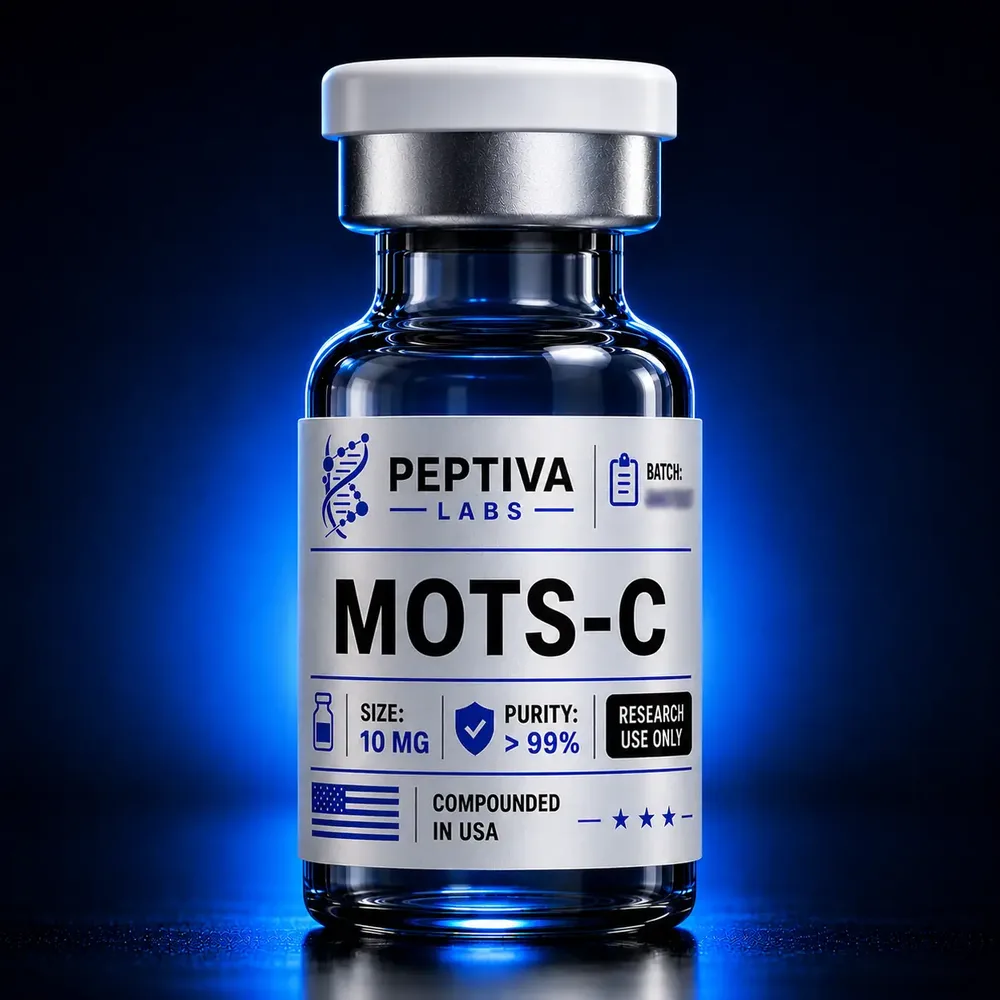
MOTS-c (Mitochondrial Open reading frame of the Twelve S rRNA type-c) is a short bioactive peptide that has drawn interest in mitochondrial and metabolic research. As one of the first characterized mitochondrial-derived peptides (MDPs), it is studied as a model for how the mitochondrial genome may encode signaling molecules that communicate with the rest of the cell. This overview summarizes what MOTS-c is and how it is examined in laboratory and preclinical settings, framed strictly for research use.
What MOTS-c is
MOTS-c is a 16-amino-acid peptide whose coding sequence is located within the mitochondrial 12S ribosomal RNA (rRNA) region. Unlike most peptides translated from the nuclear genome, MOTS-c belongs to a small class of peptides associated with short open reading frames in mitochondrial DNA. Because of this origin, it is frequently grouped with humanin and the SHLP (small humanin-like peptide) family in the broader category of mitochondrial-derived peptides.
Researchers characterize MOTS-c primarily in the context of cellular energy sensing and metabolic homeostasis. It is studied as a putative regulator that links mitochondrial status to nuclear and cytosolic responses, making it a frequent subject in investigations of how cells coordinate energy supply and demand under varying conditions.
How researchers study it: mechanism and signaling
A central theme in MOTS-c literature is its relationship to AMP-activated protein kinase (AMPK) signaling. AMPK is a conserved cellular energy sensor, and MOTS-c is examined for its apparent ability to influence this pathway and associated downstream metabolic readouts. In cell-culture and rodent model systems, investigators characterize MOTS-c in connection with:
- Glucose metabolism: how the peptide associates with glucose handling and insulin-related signaling pathways in cultured cells and animal models.
- Fatty-acid and lipid metabolism: its examined involvement in pathways governing fatty-acid utilization and metabolic flux.
- The folate-AICAR-AMPK axis: a proposed mechanism in which MOTS-c intersects with one-carbon (folate) metabolism, leading to accumulation of AICAR and activation of AMPK.
Another widely studied feature is MOTS-c nuclear translocation under metabolic stress. Researchers report that, in response to stressors such as glucose restriction or oxidative challenge, MOTS-c can move from its mitochondrial or cytosolic localization into the nucleus, where it is examined for potential interactions with stress-responsive transcription factors and antioxidant-response gene programs. This stress-dependent relocalization makes MOTS-c a useful experimental tool for studying retrograde signaling-the flow of information from mitochondria to the nucleus.
Because MOTS-c is a relatively small peptide, common laboratory methods used to study it include immunoblotting and immunofluorescence for localization, AMPK phosphorylation assays, metabolomic profiling, and reporter-gene or transcriptomic readouts in cultured cells. Animal-model work in this field is preclinical and used to explore mechanism rather than to establish any human application.
Research considerations: purity, handling, and reconstitution
For reproducible in-vitro work, peptide identity and purity are critical, since closely related sequences or degradation products can confound signaling assays. Key considerations researchers weigh include:
- Purity verification: high-purity material confirmed by HPLC and mass spectrometry helps ensure that observed effects are attributable to the intended sequence rather than impurities.
- Storage: lyophilized peptide is generally stored frozen and protected from moisture and repeated temperature cycling; reconstituted aliquots are typically kept cold and freeze-thaw cycles minimized to limit degradation.
- Reconstitution: an appropriate sterile, research-grade solvent compatible with downstream assays is selected, and working concentrations are prepared fresh where stability is a concern.
- Documentation: a Certificate of Analysis (COA) supports lot-to-lot consistency and traceability across experiments.
Maintaining consistent handling across experiments helps researchers distinguish genuine signaling outcomes from artifacts introduced by peptide instability, a recurring concern when working with small, metabolically relevant peptides.
Peptiva Research Labs supplies MOTS-c as a research-grade material, HPLC-verified and provided with a Certificate of Analysis to support purity, identity, and lot traceability for laboratory work. For Research Use Only, not for human or veterinary use.