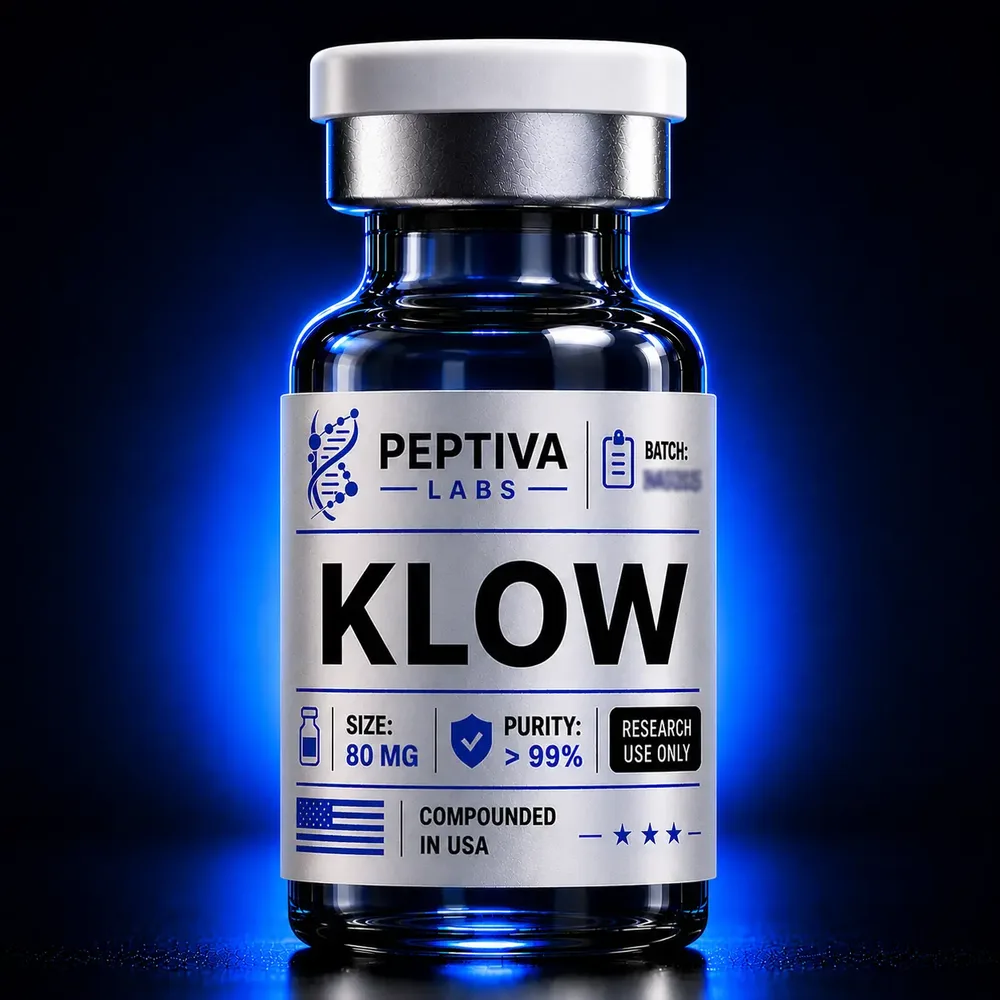
The KLOW research blend is a four-component peptide mixture that pairs KPV, BPC-157, GHK-Cu, and TB-500 in a single research preparation. It is frequently described as an extension of the three-peptide "GLOW" combination (GHK-Cu, BPC-157, and TB-500), with the addition of KPV, a short tripeptide fragment derived from the C-terminus of alpha-melanocyte-stimulating hormone (alpha-MSH) that is examined in anti-inflammatory and signaling research. Blends like KLOW are studied to characterize how multiple peptides that act on different molecular pathways behave together in an in-vitro or preclinical setting. The material described here is supplied strictly for laboratory investigation.
What it is: the four components
Each peptide in the KLOW blend belongs to a distinct structural class and is associated with a different set of studied targets and mechanisms:
- KPV, the tripeptide lysine-proline-valine, corresponding to residues 11-13 of alpha-MSH. KPV is characterized in research on melanocortin signaling and is examined in laboratory models for its interaction with inflammatory pathways, including reported effects on NF-kB signaling in cultured cells. Unlike full-length alpha-MSH, KPV lacks the pigmentation-associated sequence, making it a focus of mechanistic interest in inflammation research.
- BPC-157, a synthetic 15-amino-acid peptide whose sequence is derived from a fragment of a gastric protein. It is studied in preclinical models examining angiogenic signaling, growth-factor pathways such as VEGF, and connective-tissue and cellular-migration processes.
- GHK-Cu, the copper-binding tripeptide glycyl-L-histidyl-L-lysine complexed with copper(II). GHK-Cu is characterized in research on extracellular-matrix remodeling, copper transport, and gene-expression modulation, and is a long-standing subject of skin and fibroblast cell-culture studies.
- TB-500, a synthetic peptide corresponding to an active region of thymosin beta-4, a protein studied for its role in actin sequestration and cytoskeletal dynamics. Research examines its association with cell migration and tissue-organization pathways.
How researchers study the blend
A central question in multi-peptide blend research is whether combining compounds that engage different targets produces additive, independent, or interacting effects in a controlled system. Because KPV is associated primarily with inflammatory signaling, while BPC-157, GHK-Cu, and TB-500 are each linked to matrix, angiogenic, or cytoskeletal pathways, the KLOW combination is of interest to investigators characterizing how these distinct mechanisms coexist in the same preparation.
Typical laboratory approaches used to characterize such peptides individually and in combination include cell-culture assays, gene- and protein-expression analysis, migration and scratch-wound in-vitro models, and analytical methods such as HPLC and mass spectrometry to confirm identity and monitor stability. When peptides are blended, researchers also assess whether the components remain chemically compatible, for example, whether the copper coordination of GHK-Cu is preserved and whether any peptide shows accelerated degradation in the mixed solution. These are characterization questions, not endpoints implying any physiological outcome.
Why blend composition matters
Because each component has its own solubility profile and stability behavior, the molar and mass ratios within a blend influence how the preparation is interpreted in an experiment. Documenting the exact composition is essential for reproducibility, and researchers typically reference the certificate of analysis (COA) to confirm the identity and relative content of each peptide before designing a study.
Research handling considerations
Multi-peptide blends introduce handling considerations beyond those of a single compound, and careful technique supports data reproducibility:
- Purity and verification, confirm identity and purity of the finished blend via HPLC and review the accompanying COA, since combining peptides can complicate analytical interpretation.
- Reconstitution, lyophilized blends are typically reconstituted with bacteriostatic or sterile water added gently against the vial wall; vigorous agitation is generally avoided to limit peptide shear and to protect the copper complex in GHK-Cu.
- Storage, lyophilized material is commonly stored cold and protected from light and moisture; once reconstituted, solutions are kept refrigerated and used within a limited window. Repeated freeze-thaw cycles are minimized to preserve integrity.
- Documentation, recording lot numbers, reconstitution dates, and concentrations of each component supports traceability across experiments.
Peptiva Research Labs supplies the KLOW research blend as an HPLC-verified preparation accompanied by a certificate of analysis documenting identity and purity. This material is provided For Research Use Only, not for human or veterinary use, and is intended solely for in-vitro, laboratory, and preclinical investigation by qualified researchers.