The incretin and energy-balance receptor system has become one of the most actively characterized signaling axes in metabolic research. This guide surveys the receptors at its core, glucagon-like peptide-1 (GLP-1), glucose-dependent insulinotropic polypeptide (GIP), and glucagon, and the single, dual, and triple receptor agonist classes that laboratories examine as reference tools in cell-based and preclinical metabolic models. The discussion is intended strictly for an educational, in-vitro and laboratory audience.
What this receptor system is
GLP-1, GIP, and glucagon are members of the secretin-like peptide family, and their receptors, GLP-1R, GIPR, and GCGR, belong to the class B (secretin-like) family of G protein-coupled receptors (GPCRs). Class B GPCRs are characterized by a large extracellular N-terminal domain that captures the C-terminal portion of the peptide ligand, followed by a transmembrane domain that the peptide's N-terminus engages to trigger conformational change and receptor activation.
In intact physiology, GLP-1 and GIP are described as incretins, gut-derived signals associated with nutrient sensing, while glucagon is a counter-regulatory signal associated with hepatic energy mobilization. Because these three receptors converge on overlapping intracellular machinery yet sit on different tissues, the system is frequently studied as a model of how a small family of related ligands can produce distinct and combinatorial signaling outputs.
Signaling at the molecular level
All three receptors couple predominantly to the stimulatory G protein (Gs), and agonist binding is studied for its activation of adenylyl cyclase and the resulting rise in intracellular cyclic AMP (cAMP). Downstream of cAMP, researchers characterize protein kinase A (PKA) and the exchange protein activated by cAMP (Epac) as principal effectors. Beyond the canonical Gs-cAMP route, these receptors are also examined for beta-arrestin recruitment, receptor internalization, and biased agonism, the phenomenon in which different ligands preferentially engage some pathways over others. cAMP accumulation assays, beta-arrestin recruitment assays, and receptor-trafficking readouts are common endpoints used to compare compounds in this class.
Single, dual, and triple agonist research classes
A central theme in this field is multi-receptor targeting. Investigators study how engaging one, two, or three of these receptors with a single engineered peptide changes the signaling profile observed in receptor-expressing cell lines and metabolic models.
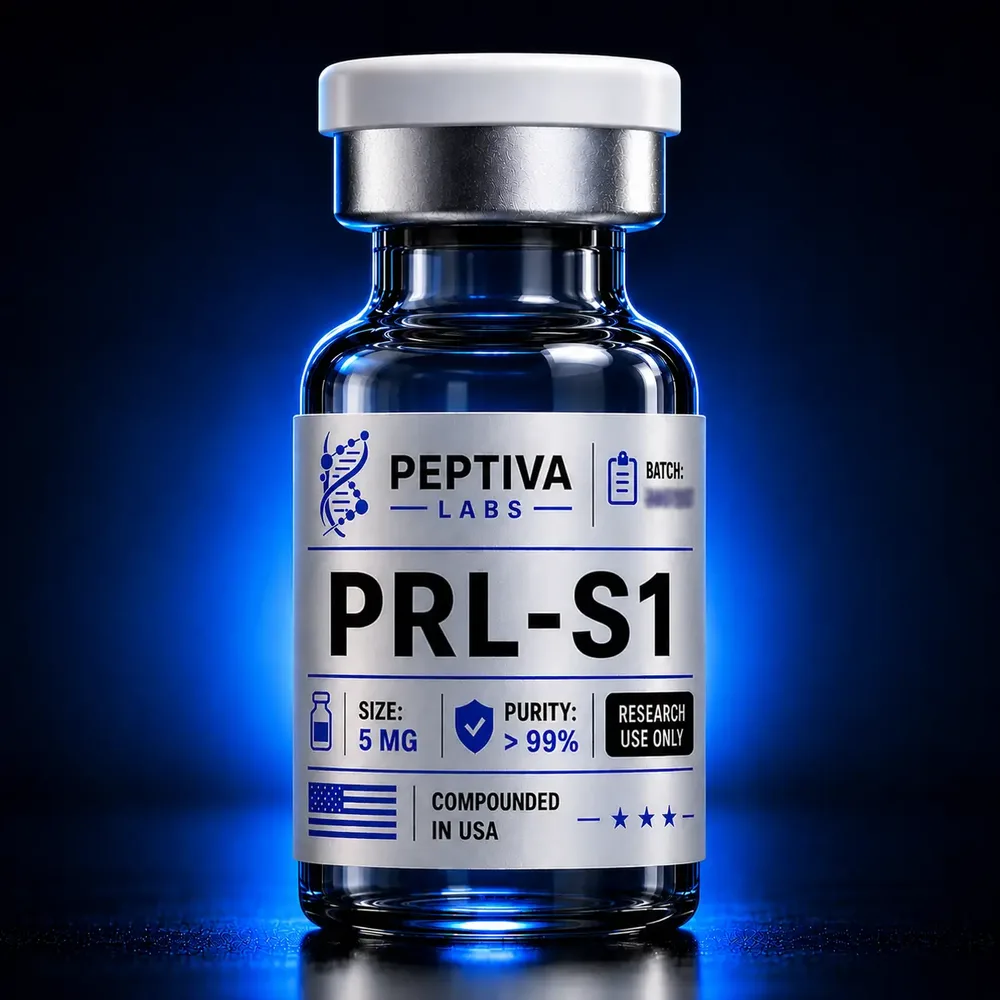
- Single agonists (GLP-1R): Peptides in the semaglutide class are examined as selective GLP-1 receptor reference agonists. Peptiva's house-coded PRL-S1 belongs to this category and is used as a comparator for GLP-1R-specific signaling readouts.
- Dual agonists (GIPR/GLP-1R): The tirzepatide class is studied as a dual GIP and GLP-1 receptor agonist, designed so that one molecule engages both receptors. Peptiva's PRL-T2 represents this dual-agonist reference class, of interest to laboratories comparing combined versus single-receptor activation.
- Triple agonists (GIPR/GLP-1R/GCGR): The retatrutide class adds glucagon receptor engagement, producing a triple agonist that activates all three receptors. Peptiva's PRL-R3 is the corresponding reference tool, studied where the glucagon-receptor arm and its contribution to energy-balance signaling are the variables under examination.
Because these molecules differ in which receptors they engage and with what relative potency, they are valuable as a graded series. Comparing PRL-S1, PRL-T2, and PRL-R3 side by side allows researchers to isolate the contribution of each receptor arm within the same experimental framework, a common approach in structure-activity and receptor-pharmacology studies.
Research considerations: purity, reconstitution, and storage
Reproducible receptor-pharmacology data depend heavily on material quality. Peptides intended as reference agonists are typically supplied as lyophilized powders, and several handling factors are routinely controlled in laboratory work.
- Purity and identity: Reverse-phase HPLC is used to assess chromatographic purity, while mass spectrometry confirms molecular identity. Impurities or truncated sequences can shift apparent potency in cAMP and binding assays, so verified material is preferred for comparative studies.
- Reconstitution: These peptides are generally solubilized in sterile or bacteriostatic water, sometimes with a small amount of buffer; the chosen solvent and concentration are documented so that assay conditions remain consistent across replicates.
- Storage and stability: Lyophilized peptide is typically stored frozen and protected from moisture and light. Reconstituted stocks are usually kept refrigerated for short-term work or aliquoted and frozen to limit freeze-thaw cycles, which can degrade peptide integrity.
Maintaining a consistent reconstitution and storage protocol across an experiment series is one of the simplest ways to keep receptor-activation readouts comparable between the single, dual, and triple agonist tools described above.
Peptiva Research Labs supplies PRL-S1 (semaglutide class), PRL-T2 (tirzepatide class), and PRL-R3 (retatrutide class) as HPLC-verified reference compounds, each accompanied by a Certificate of Analysis (COA) documenting purity and identity. All materials are offered strictly For Research Use Only, not for human or veterinary use, to support in-vitro, laboratory, and preclinical characterization of the GLP-1, GIP, and glucagon receptor system.