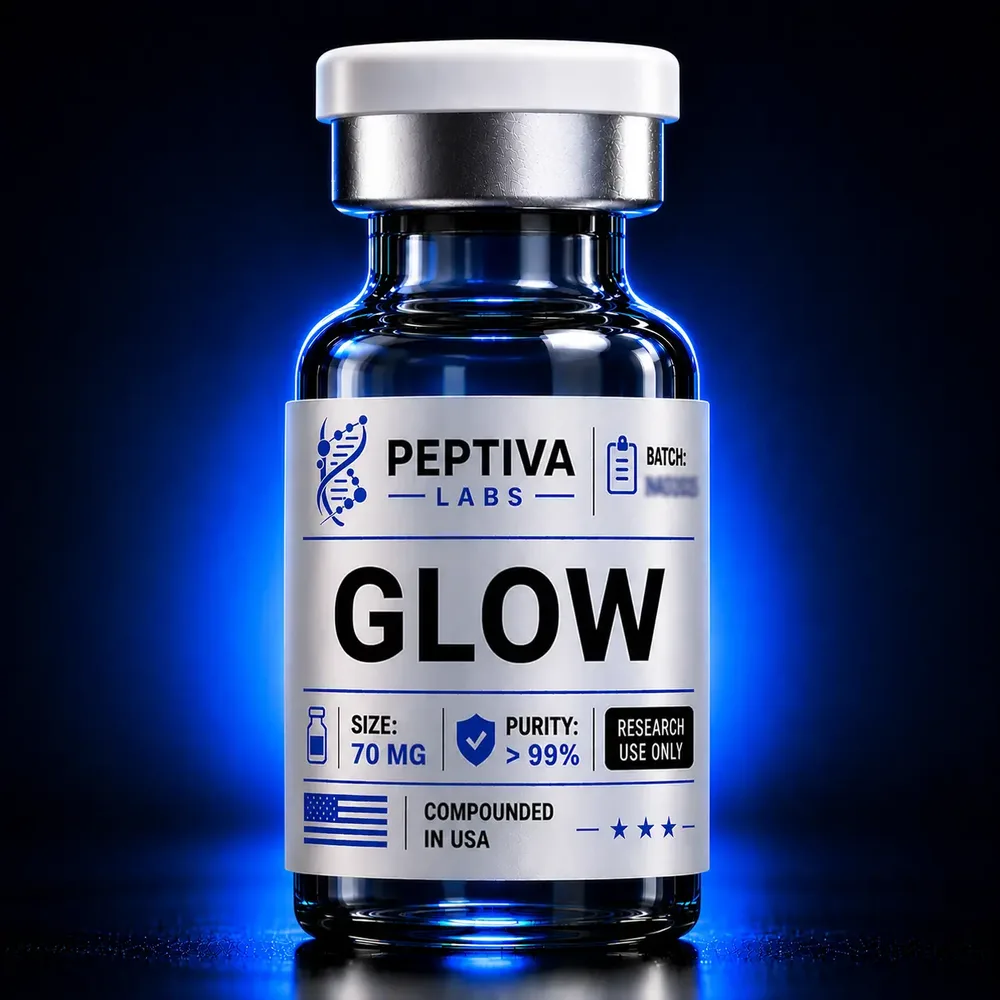
The GLOW Research Blend is a combination of three peptides, BPC-157, GHK-Cu, and TB-500, that are each independently characterized in the scientific literature for their associations with tissue-repair, extracellular-matrix, and cytoprotection pathways. Laboratories examine such blends to study whether compounds acting on distinct but complementary mechanisms produce additive or interacting effects in controlled in-vitro and preclinical models. This overview describes what each component is and how researchers approach studying them together.
What the blend is
Each component represents a different molecular class and pathway, which is the rationale most often cited for studying them as a panel rather than in isolation:
- BPC-157 is a synthetic pentadecapeptide derived from a sequence identified in gastric juice. It is studied in connection with angiogenic signaling, growth-factor expression, and cytoprotective responses in epithelial and connective-tissue models.
- GHK-Cu is a naturally occurring copper-binding tripeptide (glycyl-L-histidyl-L-lysine complexed with copper(II)). It is examined for its roles in copper transport, modulation of gene expression related to extracellular-matrix remodeling, and antioxidant-associated activity in dermal and fibroblast systems.
- TB-500 is a synthetic fragment corresponding to the active region of thymosin beta-4, a G-actin-sequestering peptide. It is studied in relation to actin dynamics, cell migration, and angiogenesis in cell-culture and animal models.
Because each peptide engages a separate node, growth-factor and angiogenic signaling (BPC-157), matrix and copper-dependent transcriptional pathways (GHK-Cu), and cytoskeletal/actin regulation (TB-500), researchers frame the blend as a tool for probing pathway intersection rather than a single-target reagent.
How researchers study it
Investigations into multi-peptide repair blends typically rely on standard laboratory endpoints rather than any applied use. Common experimental contexts include:
- Cell-migration and scratch assays, where fibroblast or endothelial monolayers are used to characterize how individual peptides versus the combination influence migration and gap closure in vitro.
- Angiogenesis models, such as tube-formation assays or chick chorioallantoic membrane preparations, used to examine vascular-related signaling endpoints associated with BPC-157 and TB-500.
- Extracellular-matrix and gene-expression profiling, where GHK-Cu is studied for its documented influence on collagen-, metalloproteinase-, and antioxidant-related transcripts.
- Combination and isobolographic analysis, in which researchers compare the measured response of the blend against the predicted sum of single-peptide responses to characterize additivity or interaction.
A central methodological question in blend research is attribution: because three peptides are present, well-designed studies include single-component and vehicle controls so that any observed effect can be assigned to a specific peptide or to the combination. Researchers also account for the fact that GHK-Cu introduces copper, which is a redox-active metal that can independently influence assay chemistry and must be controlled for separately from the peptide backbone.
Why three peptides together
The scientific interest in co-studying these peptides stems from their non-overlapping mechanisms. In tissue-repair biology, processes such as cell migration, matrix deposition, and neovascularization occur in coordinated phases, so a panel that touches multiple phases is of methodological interest for modeling that coordination. Studying them as a defined blend allows comparison against the same peptides assayed individually, helping characterize whether the pathways reinforce one another under controlled conditions.
Research considerations: purity, storage, and reconstitution
Multi-peptide blends raise handling considerations beyond those of a single compound, and rigorous characterization is essential for reproducible data:
- Purity and identity. Because three sequences are co-formulated, analytical verification (HPLC for purity and mass spectrometry for identity) of the constituent peptides supports confidence that observed effects reflect the intended molecules. A Certificate of Analysis documents the verified composition.
- Copper content. The GHK-Cu component is a defined copper complex; the copper stoichiometry is relevant to experimental design and to controlling for metal-dependent effects in sensitive assays.
- Reconstitution. Lyophilized peptides are generally reconstituted with an appropriate sterile solvent under aseptic technique. Researchers commonly determine compatibility for each component and avoid repeated freeze-thaw cycles that can degrade peptide integrity.
- Storage and stability. Lyophilized material is typically stored cold and protected from light and moisture; reconstituted solutions are usually held refrigerated and used within a characterized stability window. Aliquoting can reduce freeze-thaw exposure.
Peptiva Research Labs supplies the GLOW Research Blend as HPLC-verified material accompanied by a Certificate of Analysis documenting purity and identity, so investigators can reference defined specifications in their experimental records. For Research Use Only, not for human or veterinary use.