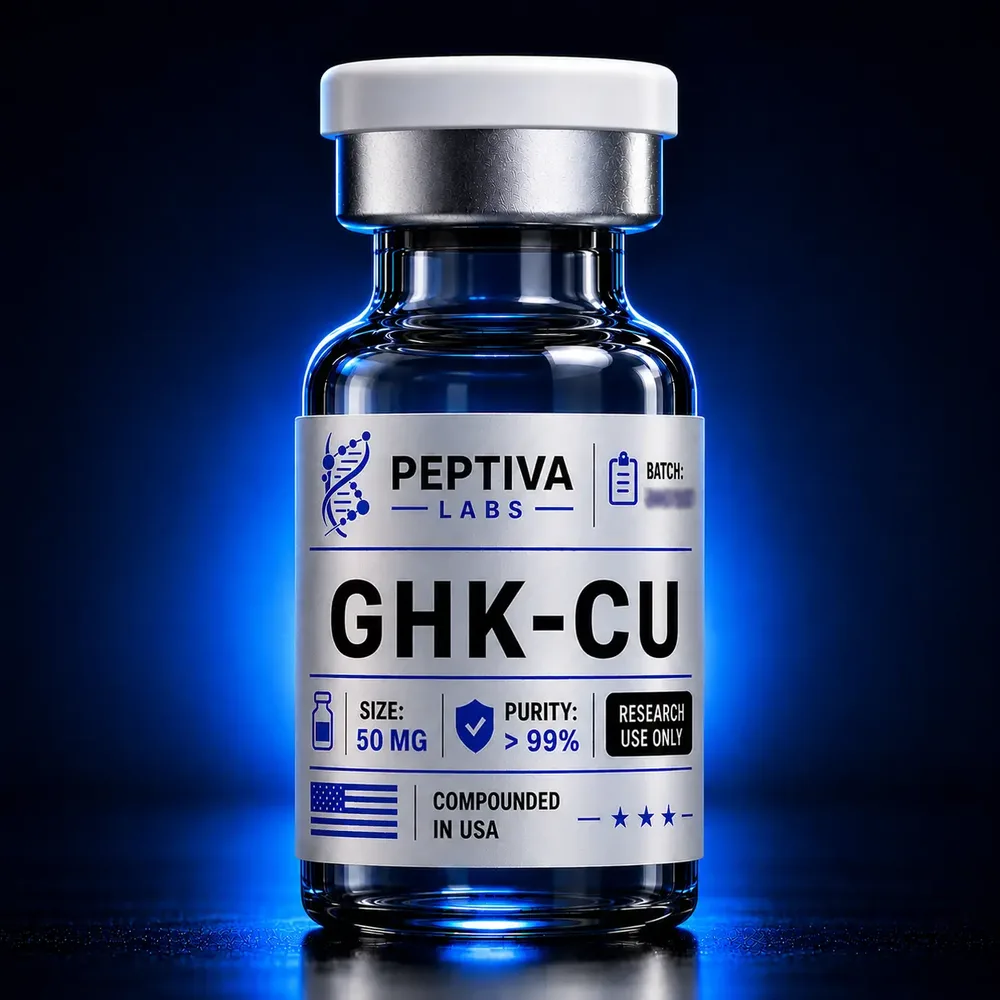
GHK-Cu is one of the most extensively characterized small peptide-metal complexes in the dermatological and regenerative research literature. It pairs the tripeptide glycyl-L-histidyl-L-lysine (GHK) with a copper(II) ion, forming a stable coordination complex that has become a frequent subject of in-vitro and preclinical investigation. This overview summarizes what the compound is at a structural and mechanistic level and what laboratories study about it, framed strictly for research use.
What GHK-Cu is
GHK is a naturally occurring tripeptide first isolated from human plasma, where its abundance is reported to decline with age in observational characterizations. Its amino acid sequence, glycine, L-histidine, L-lysine, gives it a high affinity for copper(II) ions. The imidazole nitrogen of histidine, together with backbone and terminal nitrogen donors, coordinates the copper atom to form the complex commonly written as GHK-Cu or copper tripeptide.
This copper-binding property is central to the molecule's identity. Researchers describe GHK as a physiological carrier and modulator of copper, a trace metal involved in numerous enzymatic and redox processes. Because the peptide both binds and helps shuttle copper, studies often treat the complex, rather than the free peptide, as the functional species of interest. In its supplied form it is a small, water-soluble molecule typically appearing as a blue-tinted powder, the color reflecting the bound copper ion.
How researchers study its mechanism
Much of the published interest in GHK-Cu centers on its effects on gene expression. Transcriptomic studies in cultured cells and tissue models have examined how exposure to the peptide is associated with broad shifts in the expression of large numbers of genes. Investigators characterize these patterns as modulatory, some transcripts upregulated, others downregulated, rather than acting on a single discrete receptor target.
Within the extracellular-matrix and dermal-research context, laboratories examine GHK-Cu in connection with the following processes:
- Matrix remodeling: in-vitro work characterizes its relationship to collagen, elastin, and glycosaminoglycan synthesis in fibroblast cultures, as well as to the balance of matrix metalloproteinases and their tissue inhibitors.
- Cellular signaling: researchers study its association with growth-factor and cytokine signaling pathways relevant to tissue organization and the wound-healing cascade in model systems.
- Antioxidant and redox chemistry: because copper participates in redox reactions, studies investigate how the chelated form behaves in oxidative-stress assays compared with free copper ions.
- Copper transport: the complex is examined as a vehicle for delivering copper to cells, a property frequently invoked to explain its downstream transcriptional effects.
Methodologically, GHK-Cu is a common reference compound in cell-culture proliferation assays, scratch/migration models, three-dimensional skin-equivalent constructs, and microarray or RNA-sequencing experiments. These approaches let investigators correlate peptide exposure with measurable changes in protein output and gene transcription under controlled laboratory conditions.
Research considerations: purity, reconstitution, and storage
Because GHK-Cu studies depend on a well-defined chemical species, analytical purity is a primary variable. The copper-to-peptide stoichiometry and the absence of uncomplexed peptide or free copper salts can influence experimental outcomes, so reverse-phase HPLC characterization and mass-spectrometric confirmation are standard quality checkpoints. The intact complex should display its characteristic profile, and a certificate of analysis allows researchers to document identity and purity in their methods.
For handling, the lyophilized complex is generally stored desiccated and protected from light and heat to preserve the coordination complex; many laboratories keep stock material frozen for long-term stability. Reconstitution in laboratory-grade water or an appropriate buffer is typical for in-vitro work, with attention to pH, since the copper coordination geometry can be sensitive to solution conditions. Aliquoting reconstituted stock to limit freeze-thaw cycles is a common practice to maintain consistency across experiments. As with any copper-containing reagent, researchers note potential interactions with reducing agents and chelators in assay buffers when designing controls.
Peptiva Research Labs supplies GHK-Cu (copper tripeptide) as an HPLC-verified research material accompanied by a certificate of analysis documenting identity and purity, so investigators can reference a defined specification in their experimental records. For Research Use Only, not for human or veterinary use.