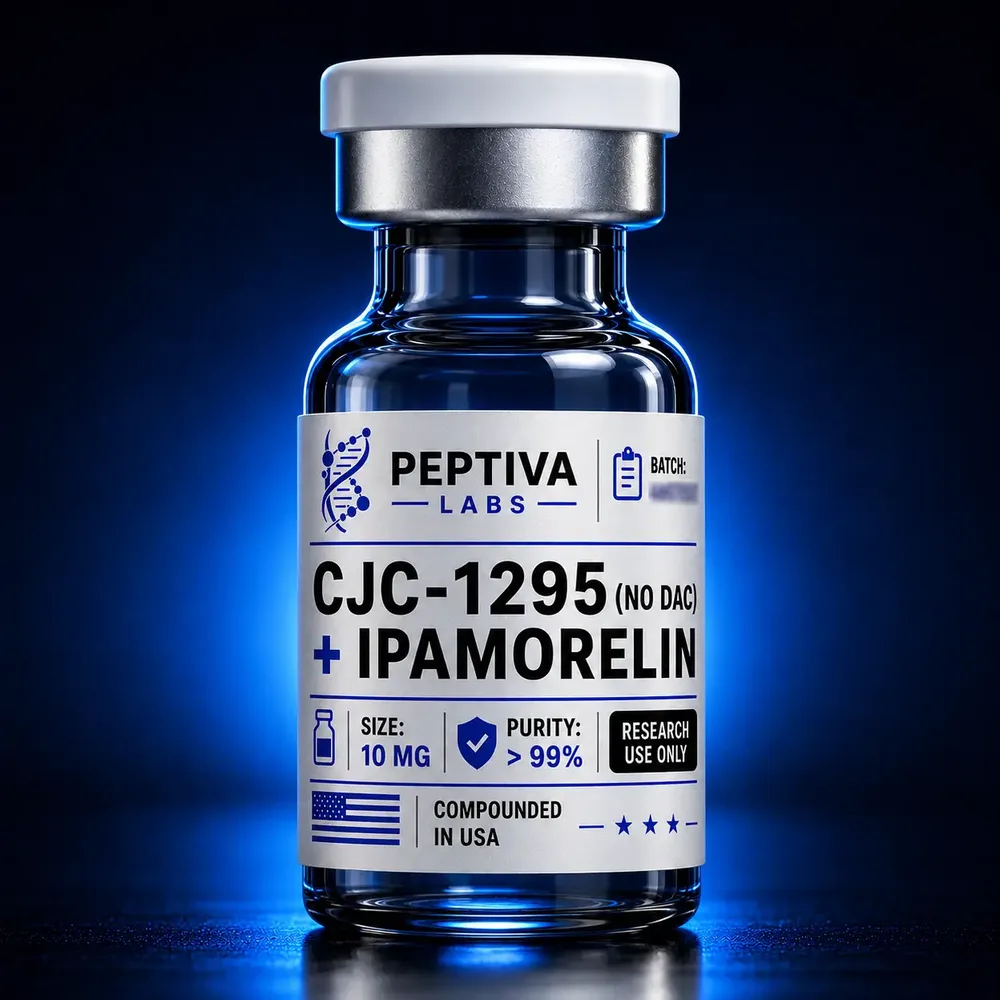
The CJC-1295 (No DAC) and Ipamorelin blend combines two synthetic peptides that act on distinct receptors within the somatotropic (growth hormone) axis. It is studied in laboratory and preclinical settings as a tool for examining how growth-hormone-releasing hormone (GHRH) signaling and ghrelin-receptor signaling interact at the level of the pituitary somatotroph. This overview describes what each component is, how the two peptides are characterized in research models, and the handling considerations relevant to in-vitro investigation. It is intended strictly for educational purposes.
What the blend is
CJC-1295 (No DAC), also referred to as Modified GRF (1-29) or Mod GRF 1-29, is a synthetic analog of the first 29 amino acids of endogenous GHRH. This 1-29 fragment retains the receptor-binding domain of the full hormone. The "No DAC" designation indicates that it lacks the Drug Affinity Complex (a maleimidoproprionic acid moiety) used in the DAC version to bind serum albumin and extend half-life. Without that modification, the peptide is short-acting and is characterized in the literature by a brief plasma profile. Stabilizing substitutions in the sequence are studied for their effect on resistance to enzymatic degradation relative to native GHRH.
Ipamorelin is a pentapeptide classified as a growth hormone secretagogue (GHS) and a synthetic agonist of the growth hormone secretagogue receptor (GHS-R1a), the receptor for the endogenous peptide ghrelin. Ipamorelin is frequently described in research as one of the more selective secretagogues in its class, a property examined in models that profile its interaction with the GHS-R relative to receptors governing other pituitary outputs.
The rationale for studying the two together is that they engage separate, complementary pathways. CJC-1295 (No DAC) acts on the GHRH receptor, while Ipamorelin acts on the ghrelin receptor. Researchers examine whether co-presentation produces signaling effects distinct from either peptide characterized alone.
How researchers study it
Investigation of this blend centers on receptor-level pharmacology and the regulation of the somatotropic axis. Common lines of inquiry in cell-based and preclinical models include:
- GHRH-receptor signaling: The GHRH receptor is a class B G-protein-coupled receptor (GPCR) coupled to Gs. Studies examine how the 1-29 analog engages this receptor and activates downstream adenylate cyclase and cyclic AMP (cAMP) cascades in somatotroph models.
- Ghrelin-receptor signaling: GHS-R1a is a Gq-coupled GPCR. Research characterizes how Ipamorelin activates phospholipase C and intracellular calcium mobilization, a pathway mechanistically distinct from the GHRH arm.
- Pathway convergence: Because the two receptors recruit different G-protein subtypes, a frequent research question is how concurrent activation is integrated at the somatotroph, and whether the combination is characterized differently from single-peptide exposure in controlled assays.
- Selectivity profiling: Ipamorelin is studied for its receptor selectivity, including assays that examine its activity relative to pathways governing other pituitary-derived hormones.
- Structure-stability relationships: The No DAC configuration is used to study a short-acting GHRH-analog profile, in contrast to albumin-binding variants designed for prolonged exposure.
These endpoints are typically assessed using receptor-binding assays, reporter systems for cAMP and calcium signaling, and cultured pituitary or transfected cell lines. All such work is conducted in vitro or in preclinical models, not in humans.
Research considerations: purity, handling, and storage
Because both peptides are studied for receptor-level activity, experimental reproducibility depends heavily on material quality and consistent handling. Relevant considerations include:
- Purity and identity: High-performance liquid chromatography (HPLC) is used to verify purity, and mass spectrometry is used to confirm identity and molecular weight. A defined blend ratio is important, since the two components are present together and each must be accurately characterized.
- Reconstitution: Lyophilized peptide is typically reconstituted with an appropriate sterile solvent for laboratory use. Gentle handling is preferred over vigorous agitation, which can stress peptide structure.
- Storage: Lyophilized material is generally stored cold and protected from light and moisture; reconstituted solutions are characterized as less stable and are kept refrigerated and used within a limited window. Repeated freeze-thaw cycles are commonly minimized in handling protocols.
- Documentation: A Certificate of Analysis (COA) supports traceability of purity, identity, and lot data for experimental records.
Peptiva Research Labs supplies the CJC-1295 (No DAC) + Ipamorelin blend as HPLC-verified material accompanied by a Certificate of Analysis documenting purity and identity for laboratory use. For Research Use Only, not for human or veterinary use.