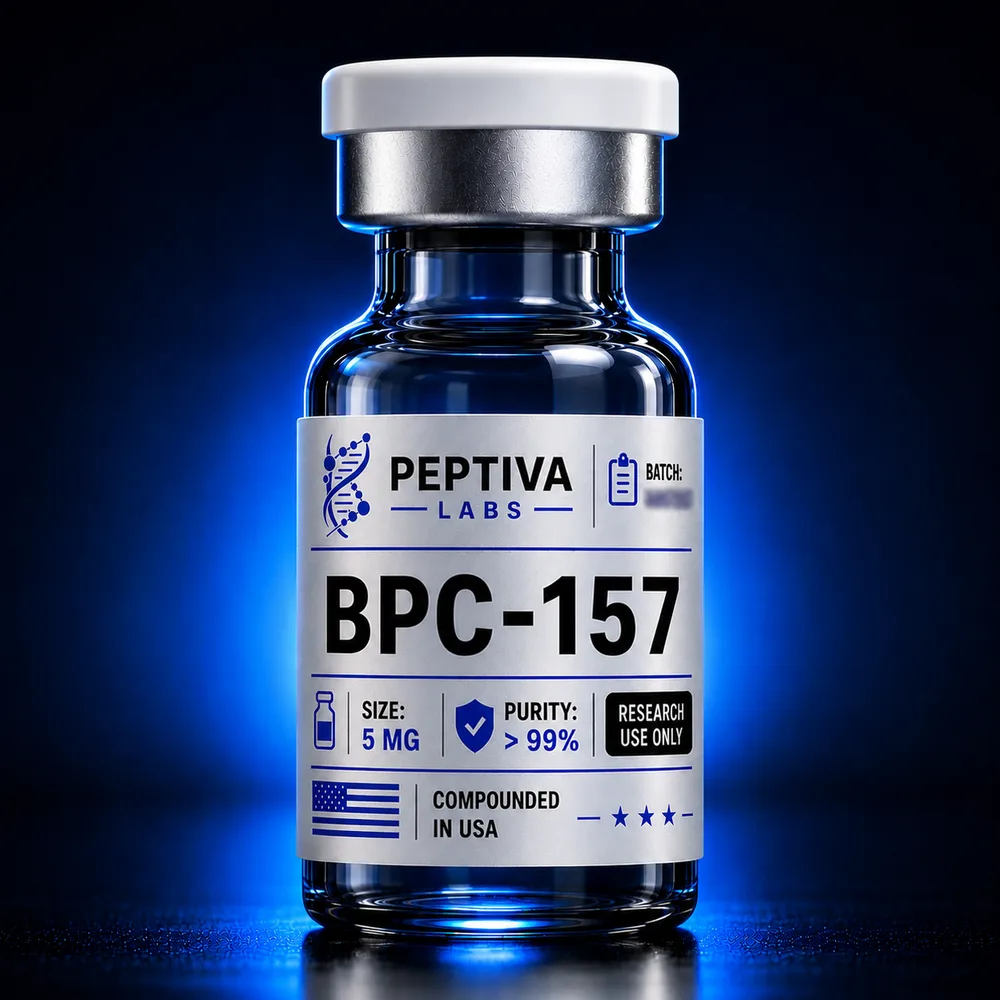
BPC-157 is a synthetic pentadecapeptide that has become a frequent subject of in-vitro and preclinical investigation. It is derived from a partial sequence of a protein originally identified in gastric juice, and it is often characterized in the literature for its notable stability under laboratory conditions. This overview summarizes what the compound is, the mechanisms researchers examine, and the handling considerations relevant to controlled laboratory work. All content here is educational and framed strictly around research-use contexts.
What BPC-157 Is
BPC-157 (the abbreviation derives from "Body Protection Compound") is a chain of 15 amino acids, hence the term pentadecapeptide. Its sequence corresponds to a fragment of a larger gastric protein, and the synthetic peptide is produced through standard solid-phase peptide synthesis rather than extraction. A defining feature noted across the literature is its reported stability: it is frequently described as resistant to hydrolysis and degradation in aqueous and certain biological media, which makes it a tractable candidate for laboratory study compared with many less stable peptides.
In classification terms, BPC-157 is studied as a cytoprotective peptide, meaning research models examine its association with cell and tissue preservation under stress conditions. It does not belong to the hormone or growth-factor families directly, but investigators study how it may intersect with several signaling pathways that those families also engage.
How Researchers Study It
Most published work on BPC-157 sits within cell-culture systems and preclinical animal models, where the peptide is examined as a tool for probing tissue-repair and angiogenesis biology. Several recurring themes appear in the mechanistic literature:
- Fibroblast and collagen activity: Researchers characterize how BPC-157 is associated with fibroblast behavior, including migration and proliferation in scratch-assay and related in-vitro models, and with collagen organization, both of which are central readouts in wound-model research.
- Angiogenesis signaling: A large portion of investigation focuses on blood-vessel formation. Studies examine the peptide's relationship to vascular endothelial growth factor (VEGF) expression and downstream receptor signaling, which are standard markers in angiogenesis assays.
- Nitric oxide (NO) pathway: The peptide is frequently studied in the context of the nitric oxide system. Researchers explore how its effects in various models may interact with NO synthesis and the broader NO-vasomotor axis, often using pathway agonists and inhibitors to probe the relationship.
- Cytoprotection under stress: Preclinical models examine the compound's association with cellular resilience when tissues or cultures are exposed to chemical, mechanical, or ischemic stressors.
Across these areas, investigators typically rely on controlled comparisons, vehicle controls, dose-response gradients, and pathway-blocking agents, to characterize whether observed effects track with a proposed mechanism. The body of evidence remains largely preclinical, and findings are described in the literature as associations observed in defined experimental systems rather than established outcomes in humans.
Common Laboratory Readouts
Researchers studying BPC-157 commonly report endpoints such as endothelial tube formation, fibroblast migration distance, collagen deposition markers, gene- and protein-expression levels for VEGF and related factors, and viability or apoptosis measures in stressed cultures. These quantitative readouts allow mechanistic claims to be examined reproducibly within an in-vitro or preclinical framework.
Research Considerations: Purity, Storage, and Reconstitution
Because peptide research depends on knowing exactly what is in the vial, analytical purity is a primary concern. Investigators generally verify identity and purity by HPLC and confirm molecular mass by mass spectrometry before beginning experiments, since impurities or truncated sequences can confound mechanistic results.
- Storage: Lyophilized peptide is typically stored desiccated and protected from light, with cold or frozen storage used for longer-term stability. Repeated freeze-thaw cycles are generally minimized to preserve integrity.
- Reconstitution: For experimental use, the lyophilized material is dissolved in an appropriate research-grade solvent or buffer compatible with the assay system, after which it is often aliquoted to reduce handling of the stock.
- Documentation: Maintaining lot-specific records, including the certificate of analysis, reconstitution date, and storage conditions, supports reproducibility and traceability across experiments.
Although BPC-157 is frequently cited for its stability advantage relative to other peptides, sound handling practices remain important for consistent, interpretable data.
Peptiva Research Labs supplies BPC-157 as a synthetic, HPLC-verified peptide accompanied by a certificate of analysis (COA) documenting identity and purity for each lot. This material is intended solely to support controlled laboratory investigation. For Research Use Only, not for human or veterinary use.